The tanh activation function — the hyperbolic tangent — squashes inputs into the range −1 to 1. It is a zero-centred cousin of the sigmoid, which historically made it the preferred choice for hidden layers and keeps it common inside recurrent networks today. This guide covers the tanh activation function’s formula, why zero-centring matters, its derivative, and Python code.
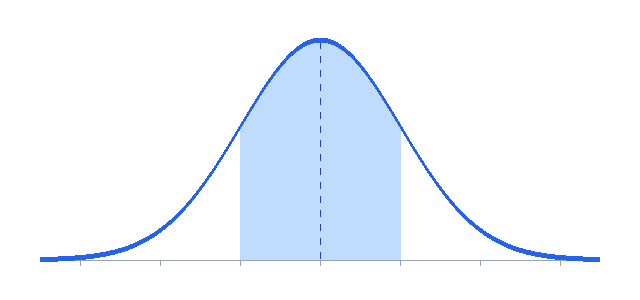
Try it: interactive tanh plot
The blue curve is the tanh activation function; the orange dashed curve is its derivative, which peaks at 1.0 — four times steeper than sigmoid.
The tanh activation function formula
The tanh activation function — the hyperbolic tangent — maps every input to the range (−1, 1). It is really just a rescaled sigmoid: tanh(x) = 2σ(2x) − 1. The crucial difference is that it is zero-centred.
Why zero-centred output matters
The derivative and its limits
Tanh activation function in Python
import numpy as np

def tanh(x):
    return np.tanh(x)

def tanh_derivative(x):
    return 1 - np.tanh(x)**2

print(tanh(np.array([-2.0, 0.0, 2.0])))
# [-0.964  0.     0.964]
See the Wikipedia hyperbolic functions article for background.
Practical tips
Scaling inputs to roughly zero mean and unit variance keeps a hyperbolic-tangent unit in its steep, responsive middle region and away from the flat tails where learning stalls. Pairing it with careful weight initialisation — Xavier/Glorot was designed with exactly these symmetric, saturating curves in mind — further protects the gradient early in training. In recurrent architectures it still shines because its bounded output keeps hidden states from drifting or exploding across long sequences, which is precisely why LSTM and GRU cells rely on it internally rather than on unbounded alternatives. If you find a deep feed-forward stack training slowly, that is usually the signal to switch the hidden layers to a rectified unit while keeping the bounded curve only where its squashing behaviour is genuinely needed, such as gates or bounded outputs. One more habit worth adopting is to watch the fraction of units sitting in the flat tails during the first few epochs; if most of them saturate immediately, your inputs or initial weights are almost certainly scaled too large, and a quick normalisation step will fix the training slowdown far more reliably than changing the activation itself.
Related activation functions
- Activation Functions — the complete guide (hub).
- Sigmoid Function — the non-centred sibling.
- ReLU — the modern default.
- Vanishing Gradient Problem — what tanh still suffers.