Poisson Distribution Calculator P(X=k)
Compute Poisson probabilities from the rate λ and number of events k.
Show working (LaTeX)
This free poisson distribution calculator computes Poisson probabilities — P(X = k), P(X ≤ k) and P(X ≥ k) — from the average rate λ and the number of events k.
How to use the poisson distribution calculator
Enter the rate λ (the average number of events) and a count k, then press Calculate. The poisson distribution calculator returns the exact probability, the cumulative probabilities and the formula step by step. It works as a poisson probability calculator and a poisson cumulative probability tool.
What is the Poisson distribution?
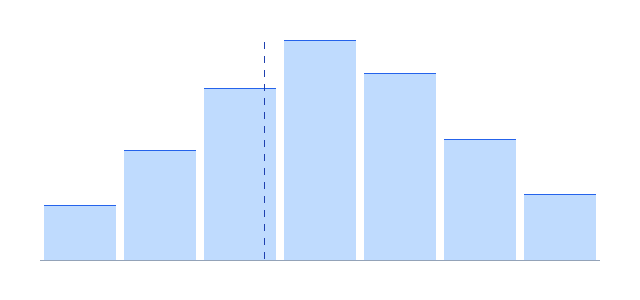
The Poisson distribution models the number of independent events in a fixed interval when they happen at a constant average rate. See the Poisson distribution reference for more.
Poisson formula
$$P(X=k)=\frac{\lambda^{k}e^{-\lambda}}{k!},\qquad \text{mean}=\text{variance}=\lambda$$How to use the Poisson formula step by step
- Identify the average rate λ for the interval.
- Pick the number of events k you want the probability of.
- Apply the formula — or read it off the calculator above.
Worked example
If a call center averages λ = 3 calls per minute, the probability of exactly 2 calls in a minute is $\frac{3^2 e^{-3}}{2!}\approx 0.224$.
Why the Poisson distribution matters in machine learning
In machine learning for beginners, the Poisson distribution models count data — clicks, arrivals, defects — and underpins Poisson regression. It connects to the broader ideas in the probability calculator and normal distribution.
🤖 ML insight
For large λ, the Poisson distribution looks almost normal — which is why count features can often be modeled with Gaussian methods after a transform.
Frequently asked questions
What does this poisson distribution calculator return?
What is λ?
Does k have to be a whole number?
When should I use the Poisson distribution?
Is the poisson distribution calculator free?
Poisson vs binomial vs normal
The Poisson model is the limit of the binomial when the number of trials is large and the success probability is small, with the rate held fixed. That is why it suits rare events — typos on a page, arrivals at a queue, radioactive decays.
As the rate grows, the shape becomes more symmetric and starts to resemble a normal curve, so for large counts a Gaussian approximation works well. A key assumption is that events are independent and occur at a constant average rate; if the rate drifts over time, a single model will not fit.
Poisson distribution calculator: summary
This poisson distribution calculator gives exact and cumulative probabilities with the formula shown. Pair it with the probability calculator and the normal distribution calculator.