Probability Calculator events
Find the probability of a single event, or combine two events (AND, OR, neither).
Assumes A and B are independent events.
Show working
This free probability calculator finds the probability of a single event or combines two independent events — P(A and B), P(A or B) and more — with the working shown.
How to use the probability calculator
Pick a mode in the probability calculator above. For a single event, enter the favorable and total outcomes. For two events, enter P(A) and P(B) and this probability calculator returns the AND, OR and complement probabilities. It doubles as a conditional probability calculator companion and a single event probability tool.
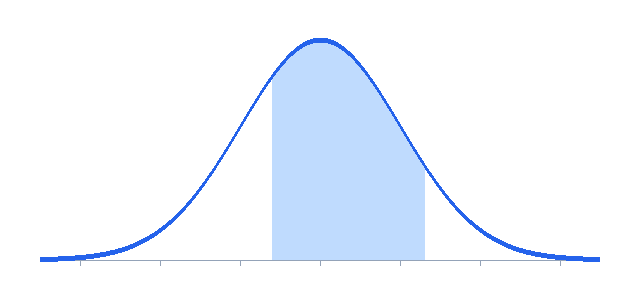
What is probability?
Probability measures how likely an event is, on a scale from 0 (impossible) to 1 (certain). See the probability reference for the foundations.
Probability formulas
$$P(A)=\frac{\text{favorable}}{\text{total}}\qquad P(A\cap B)=P(A)P(B)\qquad P(A\cup B)=P(A)+P(B)-P(A\cap B)$$How to calculate probability step by step
- Count the favorable outcomes.
- Count the total possible outcomes.
- Divide favorable by total — or combine events with the rules above.
Worked example
Drawing a heart from a standard 52-card deck: 13 favorable out of 52, so $P=\frac{13}{52}=0.25$ (25%).
Why probability matters in machine learning
Probability is the language of machine learning for beginners — classifiers output probabilities, and tests of significance rely on the p-value and the z-score.
🤖 ML insight
A classifier like logistic regression doesn’t output a label directly — it outputs a probability, and you choose a threshold (often 0.5) to turn it into a decision.
Frequently asked questions
What can this probability calculator do?
What is the range of a probability?
What does independent mean?
How do I get a percentage?
Is the probability calculator free?
Conditional probability and dependent events
When two events are dependent, the chance of both happening uses conditional probability: $P(A\cap B)=P(A)\,P(B\mid A)$, where $P(B\mid A)$ is the chance of B given that A has already happened. The two-event mode above assumes independence, so reach for this rule whenever one outcome changes the odds of the next — such as drawing cards without replacement.
Three more ideas cover most problems. Mutually exclusive events cannot occur together, so $P(A\cap B)=0$ and $P(A\cup B)=P(A)+P(B)$. The complement rule, $P(\text{not }A)=1-P(A)$, is often the fastest route when the event you want is awkward to count directly. And for a run of independent events, multiply their individual chances together to get the chance they all occur.
Probability calculator: summary
From card draws to combining events, this probability calculator gives clear answers with the formulas shown. Pair it with the p value calculator and the z-score calculator.