P-Value Calculator z & t
Turn a z-score or t-score into a p-value for one- or two-tailed tests.
Show working
Two-tailed p = 2×P(|Z| > |stat|). Reject H₀ when p ≤ your significance level (often 0.05).
This free p value calculator converts a z-score or t-score into a p-value for one- or two-tailed tests, and tells you whether the result is statistically significant.
How to use the p value calculator
Enter your test statistic, choose the distribution (z or t), pick the tail, and press Calculate. The p value calculator returns the exact p-value and flags significance at the 0.05 level. It works as a z score to p value calculator and a t test p value calculator in one.
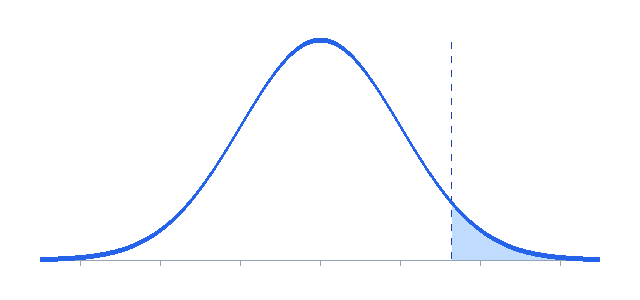
What is a p-value?
A p-value is the probability of observing a result at least as extreme as your data, assuming the null hypothesis is true. See the p-value reference for the formal definition.
“A small p-value doesn’t prove your hypothesis — it just means the data would be surprising if the null were true.”
How to find a p-value step by step
- Compute your test statistic (a z-score or t-score). Need it? Use the z-score calculator.
- Choose one-tailed or two-tailed based on your hypothesis.
- Read the tail area under the curve — that’s the p-value.
P-value to significance table
| p-value | Interpretation |
|---|---|
| p ≤ 0.01 | Very strong evidence against H₀ |
| p ≤ 0.05 | Significant (common threshold) |
| 0.05 < p ≤ 0.10 | Marginal / suggestive |
| p > 0.10 | Weak or no evidence |
Why p-values matter in machine learning
In machine learning for beginners, p-values help with feature selection and A/B testing — deciding whether a difference in model performance is real or just noise. They build directly on the standard deviation and z-score.
🤖 ML insight
When you A/B test two models, the p-value tells you whether the winner is genuinely better or whether the gap could be random sampling noise.
Frequently asked questions
What test statistics does this p value calculator accept?
One-tailed or two-tailed — which do I pick?
What p-value is significant?
Does a small p-value prove my hypothesis?
Is the p value calculator free?
One-tailed vs two-tailed tests
Choosing the tail matters. A two-tailed test asks whether a value differs from what is expected in either direction, splitting the significance level across both tails. A one-tailed test asks a directional question — specifically greater, or specifically less — and puts the whole significance level in one tail. That makes significance easier to reach, but it is only valid when you fix the direction before seeing the data.
Significance is also not the same as importance. With a very large sample, even a tiny, meaningless difference can produce a small result, so always report the effect size next to it. And never “p-hack” by trying many tests until one dips below 0.05 — that inflates false positives.
P value calculator: summary
From t-tests to A/B tests, this p value calculator turns your statistic into a clear, significance-tested p-value. Pair it with the z-score calculator and the standard deviation calculator.