Mean Calculator average
Find the mean (average) of any list of numbers, with the sum and count shown.
Separate with commas, spaces or new lines. Decimals and negatives are fine.
Show working (LaTeX)
This free mean calculator finds the average of any list of numbers in one click, and also shows the sum, count, median, range and more.
How to use the mean calculator
Paste or type your numbers into the mean calculator above and press Calculate. This average calculator instantly returns the arithmetic mean along with the supporting statistics, and shows the formula step by step. You can paste a column straight from a spreadsheet.
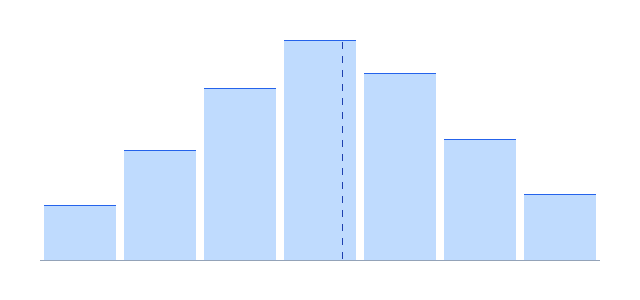
What is the mean?
The mean, or arithmetic mean, is the sum of all values divided by how many there are. See the mean reference for related averages.
Mean formula
$$\bar{x}=\frac{x_1+x_2+\cdots+x_n}{n}=\frac{1}{n}\sum_{i=1}^{n} x_i$$How to calculate the mean step by step
- Add up all the values.
- Count how many values there are.
- Divide the sum by the count.
Worked example
For 12, 7, 9, 14, 21, 10: sum = 73, count = 6, so the mean is $73 \div 6 \approx 12.1667$.
Why the mean matters in machine learning
The mean is everywhere in machine learning for beginners: it centers data during standardization and is the basis of the standard deviation and the z-score.
🤖 ML insight
Mean-centering (subtracting the mean from each feature) is the first step of standardization and of PCA — it moves the data so its average sits at the origin.
Frequently asked questions
What does this mean calculator compute?
Can I paste numbers from Excel?
What is the difference between mean and average?
Is the mean affected by outliers?
Is the mean calculator free?
Types of mean
The arithmetic average is the most common, but not the only one. The geometric mean multiplies the values and takes the nth root, which suits growth rates and ratios. The harmonic mean — the reciprocal of the average of reciprocals — is the right choice for rates such as speed. For most everyday data, the ordinary arithmetic average is what you want.
When a data set is skewed or holds outliers, report the median next to the average for an honest picture. A weighted average helps when some values count more than others: multiply each value by its weight, add the results, and divide by the total weight.
Mean calculator: summary
This mean calculator gives you the average and the working in one click. Compare it with the median calculator and the standard deviation calculator.