What Is a 2×2 Matrix?
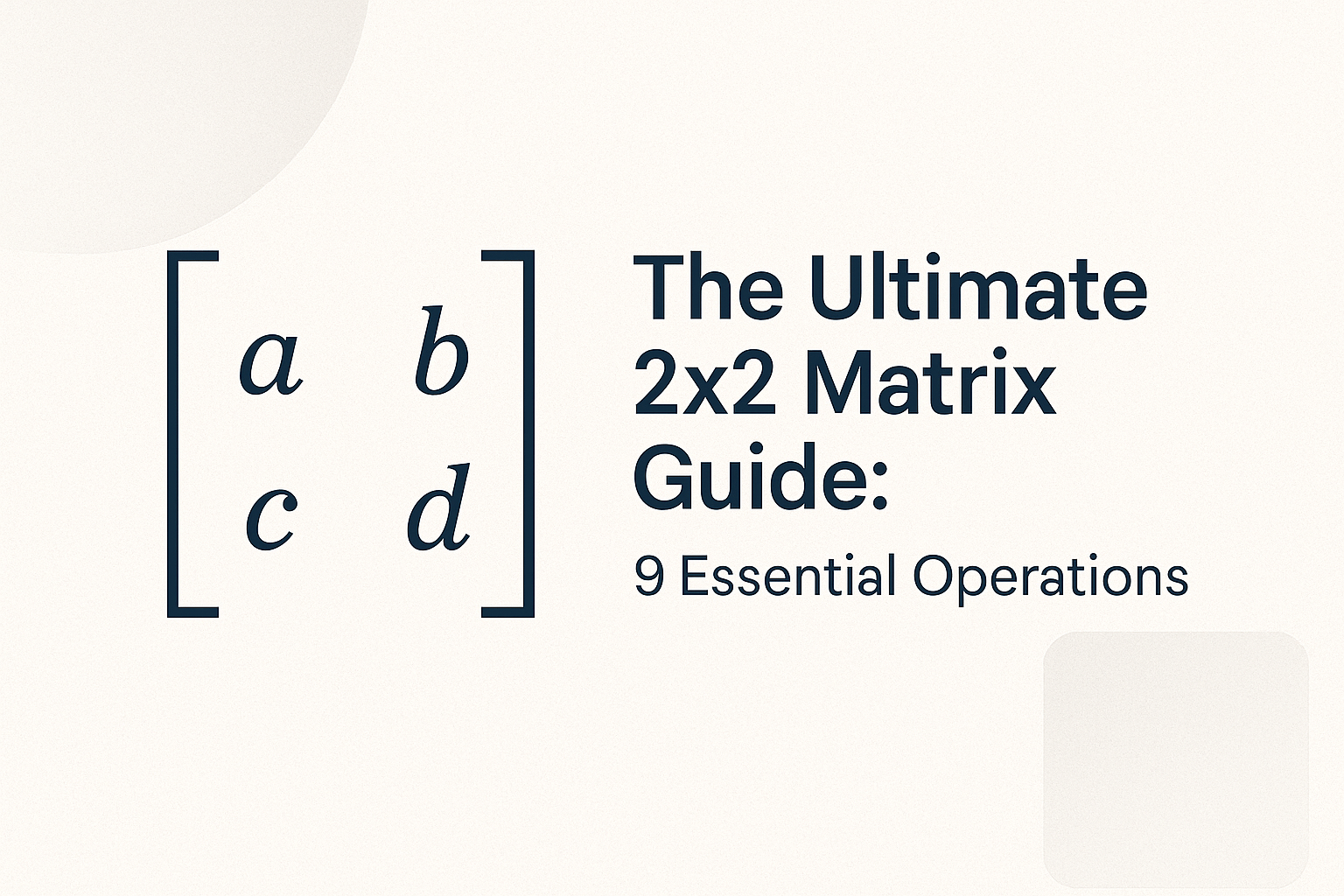
A 2×2 matrix is the simplest square matrix in linear algebra. It has two rows and two columns, usually written as
Despite its small size, this square structure is a powerhouse: it models rotations, scaling, shearing, and reflections in 2D space. Any student of machine learning, computer graphics, or physics will encounter it early. This hub article gives you a high-level tour of nine key operations on such a matrix, each with its own deep‑dive spoke article.
🔑 Key Takeaways
- The 2×2 matrix is the foundation of linear algebra – learn it well.
- Nine key operations are covered, each with a dedicated spoke article.
- Worked examples with real numbers make each concept concrete.
- Common mistakes, pro tips, and a pros‑cons table help you apply them correctly.
Inverse of a 2×2 Matrix
The inverse of a 2×2 matrix $A = \begin{bmatrix}a&b\\c&d\end{bmatrix}$ is given by
It exists only if the determinant $ad-bc \neq 0$. The inverse lets you solve linear equations and undo transformations. For a full walkthrough with three worked examples, see our dedicated guide on the inverse of a 2×2 matrix.
Determinant of a 2×2 Matrix
The determinant of a 2×2 matrix is $ad-bc$. It tells you if the matrix is invertible and how much the transformation scales area. A zero determinant means the matrix collapses the plane into a line or point. For a deeper dive, check out our determinant of a 2×2 matrix spoke article.
2×2 Matrix Multiplication
Multiplying two 2×2 matrices is a cornerstone operation. Given $A$ and $B$, the product $AB$ is another 2×2 matrix where each entry is the dot product of a row of $A$ with a column of $B$. Example: let $A = \begin{bmatrix}1&2\\3&4\end{bmatrix}$ and $B = \begin{bmatrix}0&1\\1&0\end{bmatrix}$. Then $AB = \begin{bmatrix}2&1\\4&3\end{bmatrix}$ but $BA = \begin{bmatrix}3&4\\1&2\end{bmatrix}$. The order matters: $AB \neq BA$ generally. For step‑by‑step examples, visit How to Multiply 2×2 Matrices.
Eigenvalues of a 2×2 Matrix
Eigenvalues of a 2×2 matrix solve $\det(A – \lambda I)=0$, giving a quadratic $\lambda^2 – \text{tr}(A)\lambda + \det(A)=0$. They reveal the scaling along special directions (eigenvectors). For a full treatment, see our eigenvalues of a 2×2 matrix guide.
“The eigenvalues of a 2×2 matrix are its fingerprint — they tell you everything about its long‑term behaviour.”
2×2 Identity Matrix
The 2×2 identity matrix is $I_2 = \begin{bmatrix}1&0\\0&1\end{bmatrix}$. Multiplying any 2×2 matrix by $I_2$ leaves it unchanged. It’s the neutral element in matrix multiplication, analogous to the number 1. Our dedicated identity article explores its role in inverses and proofs.
Transpose of a 2×2 Matrix
The transpose flips a 2×2 matrix over its main diagonal: if $A = \begin{bmatrix}a&b\\c&d\end{bmatrix}$, then $A^T = \begin{bmatrix}a&c\\b&d\end{bmatrix}$. It’s key in symmetry and orthogonal matrices. For more, see the transpose of a 2×2 matrix spoke.
How to Diagonalize a 2×2 Matrix
Diagonalizing a 2×2 matrix means finding an invertible $P$ and diagonal $D$ such that $A = PDP^{-1}$. This requires two linearly independent eigenvectors. Our how to diagonalize a 2×2 matrix article walks through the full algorithm.
🧪 Worked example
Eigenvalues: $\lambda_1 = 5, \lambda_2 = 2$.
Eigenvectors: $v_1 = (1,1), v_2 = (1,-2)$.
Then $P = \begin{bmatrix}1&1\\1&-2\end{bmatrix}$, $D = \begin{bmatrix}5&0\\0&2\end{bmatrix}$, and $A = PDP^{-1}.
Cross Product of 2×2 Matrices
The cross product of a 2×2 matrix is not a standard operation; rather, the determinant of the matrix formed by two vectors gives the signed area of the parallelogram they span. Still, the term is sometimes used in vector calculus. Our cross product of a 2×2 matrix article clarifies the confusion.
Jacobian Matrices 2×2
The Jacobian of a function $f: \mathbb{R}^2 \to \mathbb{R}^2$ is a 2×2 matrix of partial derivatives. It approximates the function locally. Its determinant tells you how the function scales area. For example, $f(u,v) = (u^2, uv)$ gives Jacobian $\begin{bmatrix}2u&0\\v&u\end{bmatrix}$. Learn more in the Jacobian matrix 2×2 guide.
At-a-Glance: 2×2 Matrices Operations
| Operation | Formula | Watch out for |
|---|---|---|
| Inverse | $\frac{1}{\det} \begin{bmatrix}d&-b\\-c&a\end{bmatrix}$ | Determinant must be non‑zero |
| Determinant | $ad-bc$ | Equal zero → singular |
| Multiplication | $AB_{ij} = \sum_k A_{ik}B_{kj}$ | Order matters |
| Eigenvalues | $\lambda^2 – \text{tr}\lambda + \det = 0$ | Need quadratic solver |
| Transpose | $A^T_{ij} = A_{ji}$ | Simple swap of rows & columns |
Pros & Cons of Using 2×2 Matrices
✅ Pros
- Simple formulas – inverse, determinant, eigenvalues are easy to compute.
- Foundational for understanding larger matrices.
- Widely used in 2D graphics, robotics, and data science.
❌ Cons
- Limited to 2D transformations; can’t model 3D without extension.
- Determinant condition can be too restrictive for some applications.
- Small size makes it less representative of real‑world large systems.
Frequently Asked Questions
What is a 2×2 matrix?+
A 2×2 matrix is a rectangular array of four numbers arranged in two rows and two columns, typically written as [[a, b], [c, d]]. It is the smallest square matrix and is fundamental in linear algebra for transformations, solving systems, and more.
How do you find the inverse of a 2×2 matrix?+
For a 2×2 matrix A = [[a, b], [c, d]], the inverse is (1/(ad-bc)) * [[d, -b], [-c, a]], provided the determinant ad-bc is non-zero.
What is the determinant of a 2×2 matrix?+
The determinant of a 2×2 matrix [[a, b], [c, d]] is ad – bc. It indicates whether the matrix is invertible and the scaling factor of the linear transformation.
How do you multiply two 2×2 matrices?+
To multiply two 2×2 matrices, take the dot product of the rows of the first matrix with the columns of the second. The result is another 2×2 matrix. Order matters: AB is generally not equal to BA.
What are eigenvalues of a 2×2 matrix?+
Eigenvalues of a 2×2 matrix are scalars λ satisfying det(A – λI) = 0, which leads to a quadratic equation. They represent the scaling factors of eigenvectors under the linear transformation.
For further reading on larger matrices, check our 3 by 3 Matrix: The Essential 2026 Guide and Matrix Multiplication Dimensions: The Ultimate Guide.
Ready to go deeper?
Pick any operation above and read the full dedicated guide.
Start with Multiplication →For a video overview, search 2×2 matrix tutorials on YouTube.