Jacobian Matrix 2×2: A Complete Guide with Examples (2025)

The jacobian matrix 2×2 is a compact tool that captures all first-order partial derivatives of a function from $\mathbb{R}^2$ to $\mathbb{R}^2$ — it tells you how a small change in inputs changes outputs, and it’s the heart of linear approximation in multivariable calculus.
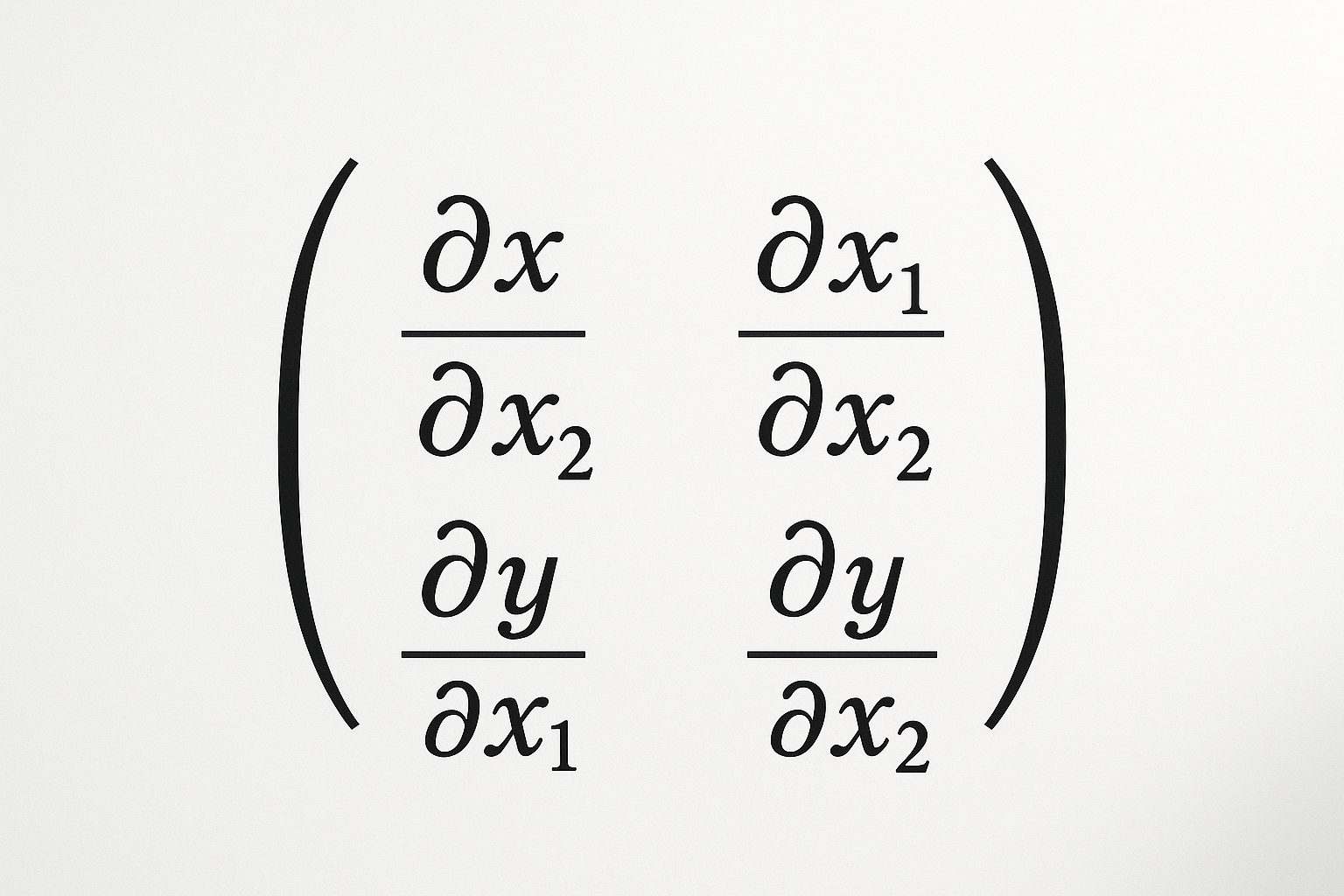
✅ Quick answer: A jacobian matrix 2×2 is a $2 \times 2$ matrix of partial derivatives that linearly approximates a vector-valued function $\mathbf{f}(x,y) = (u(x,y), v(x,y))$. It’s defined as $J = \begin{bmatrix} \frac{\partial u}{\partial x} & \frac{\partial u}{\partial y} \\ \frac{\partial v}{\partial x} & \frac{\partial v}{\partial y} \end{bmatrix}$.

🔑 Key Takeaways

  • The jacobian matrix 2×2 linearises a function near a point — think of it as a local slope, but for multiple variables.
  • Computing this 2×2 matrix is straightforward: take four partial derivatives and arrange them.
  • Its determinant reveals whether the transformation is invertible near that point.
  • It’s widely used in robotics, fluid dynamics, optimisation, and machine learning.
  • Common mistakes include mixing up partial derivatives or forgetting the order of rows/columns.

What is a Jacobian Matrix 2×2?

Imagine you have a function that takes a pair of numbers and spits out another pair — for instance, a robot arm moving in two dimensions, or a weather model mapping pressure and temperature to wind speed and humidity. How does the output change when you nudge the input a tiny bit? That’s exactly what the jacobian matrix 2×2 answers. It’s the multivariable analogue of the ordinary derivative $f'(x)$ from single‑variable calculus.

Formally, if you have a differentiable function $\mathbf{f}: \mathbb{R}^2 \to \mathbb{R}^2$ defined by $\mathbf{f}(x,y) = (u(x,y), v(x,y))$, the jacobian matrix 2×2 at a point $(x_0, y_0)$ is:

$$ J = \begin{bmatrix} \frac{\partial u}{\partial x}(x_0,y_0) & \frac{\partial u}{\partial y}(x_0,y_0) \\ \frac{\partial v}{\partial x}(x_0,y_0) & \frac{\partial v}{\partial y}(x_0,y_0) \end{bmatrix} .$$

Each entry tells you the sensitivity of one output component to one input component. Together, they form the best linear approximation to $\mathbf{f}$ near that point. In short, the jacobian matrix 2×2 is the local slope matrix.

“The 2×2 Jacobian is the local derivative of a multi‑input, multi‑output function — it tells you everything about the instantaneous rate of change in every direction.”

Formula and Notation

The jacobian matrix 2×2 is always written with the output partial derivatives in rows and input partials in columns. Standard notation uses $J$ or $D\mathbf{f}$. For the function $\mathbf{f}(x,y) = (u, v)$, we have:

$$ J = \begin{bmatrix} u_x & u_y \\ v_x & v_y \end{bmatrix}, \quad \text{where } u_x = \frac{\partial u}{\partial x}, \; u_y = \frac{\partial u}{\partial y} \dots $$

Notice the order: the first column is derivatives with respect to $x$, the second column with respect to $y$. This convention matches the chain rule and makes matrix multiplication seamless.

💡 Pro tip: When computing a 2×2 Jacobian, always double‑check which variable you’re differentiating with respect to — swapping columns is the most frequent error I see beginners make.

How to Compute a Jacobian Matrix 2×2

Computing the jacobian matrix 2×2 is mechanical once you know how to take partial derivatives. Follow these steps:

  1. Write your function as $\mathbf{f}(x,y) = (u(x,y), v(x,y))$.
  2. Compute $\frac{\partial u}{\partial x}$ — treat $y$ as constant.
  3. Compute $\frac{\partial u}{\partial y}$ — treat $x$ as constant.
  4. Compute $\frac{\partial v}{\partial x}$ and $\frac{\partial v}{\partial y}$ similarly.
  5. Arrange them in the $2 \times 2$ matrix: top row for $u$, bottom row for $v$.

That’s it! The resulting Jacobian gives you a linear map that approximates the function at that point.

⚠️ Avoid this: A common mistake is to mistakenly write $\frac{\partial v}{\partial x}$ in the first row. Remember: each row corresponds to an output component. If the function outputs $(u,v)$, then row 1 is $u$’s partials, row 2 is $v$’s.

Worked Example: Computing a Jacobian Matrix 2×2

Let’s make it concrete. Consider the function:

$$ \mathbf{f}(x,y) = (x^2 y, \sin(x) + y). $$

Here $u(x,y) = x^2 y$ and $v(x,y) = \sin(x) + y$. We compute the partial derivatives:

  • $u_x = \frac{\partial}{\partial x}(x^2 y) = 2xy$
  • $u_y = \frac{\partial}{\partial y}(x^2 y) = x^2$
  • $v_x = \frac{\partial}{\partial x}(\sin x + y) = \cos x$
  • $v_y = \frac{\partial}{\partial y}(\sin x + y) = 1$

The jacobian matrix 2×2 is therefore:

$$ J(x,y) = \begin{bmatrix} 2xy & x^2 \\ \cos x & 1 \end{bmatrix}. $$

At the point $(x,y) = (1, \pi)$, we substitute to get:

$$ J(1,\pi) = \begin{bmatrix} 2\pi & 1 \\ \cos(1) & 1 \end{bmatrix} \approx \begin{bmatrix} 6.283 & 1 \\ 0.540 & 1 \end{bmatrix}. $$

That 2×2 Jacobian now tells us how $\mathbf{f}$ changes near $(1,\pi)$. For small changes $(\Delta x, \Delta y)$, the change in output is approximately $J \cdot (\Delta x, \Delta y)^T$.

🧪 Worked example

For the function $\mathbf{f}(x,y) = (x^2 y, \sin x + y)$:

  1. Compute partials: $u_x = 2xy$, $u_y = x^2$, $v_x = \cos x$, $v_y = 1$.
  2. Assemble $J = \begin{bmatrix}2xy & x^2 \\ \cos x & 1\end{bmatrix}$.
  3. Evaluate at $(1,\pi)$: $J = \begin{bmatrix}2\pi & 1 \\ \cos 1 & 1\end{bmatrix}$.

The resulting Jacobian matrix predicts local change.

Real-World Applications of the Jacobian Matrix 2×2

The jacobian matrix 2×2 appears across engineering and science wherever you need to understand how a system responds to small changes. Here are three key areas:

1. Robotics — Velocity Kinematics

In a planar two‑joint robot arm, the mapping from joint angles $( \theta_1, \theta_2 )$ to end‑effector position $(x,y)$ is nonlinear. The 2×2 Jacobian of this mapping relates joint velocities to end‑effector velocity. It’s the core of real‑time motion control and singularities analysis.

2. Image Processing — Optical Flow

When tracking motion between two video frames, the brightness change at each pixel can be approximated by a 2×2 system involving space and time derivatives. The resulting 2×2 Jacobian appears in the Lucas‑Kanade method for optical flow estimation.

3. Optimisation — Newton’s Method for Systems

Solving a system of two nonlinear equations $F(x,y)=0$ uses the Jacobian matrix in the iterative update steps. The method converges quadratically when you have a good initial guess and the Jacobian is invertible.

🤔 Did you know? The Jacobian matrix is named after Carl Gustav Jacob Jacobi, a 19th-century German mathematician. He introduced it in a paper on determinants in 1841 — the same determinant that tells you if the transformation is invertible. A 2×2 Jacobian with zero determinant indicates a critical point or singularity.

Common Mistakes and Tips

Even experienced practitioners make errors with the jacobian matrix 2×2. Watch out for these:

  • Wrong ordering: Mixing up rows and columns leads to the transpose of the Jacobian. Always place output partials in rows, input partials in columns.
  • Confusing the Jacobian determinant: The determinant of the 2×2 Jacobian is a scalar that indicates local area scaling. It’s not the matrix itself.
  • Forgetting to evaluate at the point: The Jacobian is location‑dependent — you must plug in the specific coordinates after computing the symbolic derivatives.
ℹ️ Note: In many textbooks, the Jacobian matrix is sometimes written with derivative notation $D\mathbf{f}$ or $f’(\mathbf{x})$. The 2×2 case is just the special situation when the domain and codomain are both two‑dimensional.

Pros and Cons of Using the Jacobian Matrix 2×2

✅ Pros

  • Provides a simple linear approximation of complex nonlinear functions.
  • Essential for stability analysis and control systems.
  • Easy to compute with basic calculus.
  • Widely supported in software like MATLAB and Python (NumPy).

❌ Cons

  • Only accurate for small perturbations; large steps break the approximation.
  • Requires the function to be differentiable (not all functions are).
  • If the determinant is zero, the Jacobian gives no local inverse — that’s a singularity.

Frequently Asked Questions

What is a Jacobian matrix 2×2?+

A 2×2 Jacobian matrix is a matrix of all first-order partial derivatives of a vector-valued function from R² to R². It describes how the function behaves locally and is used for linear approximation and transformation.

How do you compute a Jacobian matrix 2×2?+

Given a function f(x,y) = (u(x,y), v(x,y)), take the partial derivatives du/dx, du/dy, dv/dx, dv/dy and arrange them in the matrix: J = [[du/dx, du/dy], [dv/dx, dv/dy]].

What does a zero determinant of the Jacobian matrix 2×2 mean?+

A zero determinant means the linear transformation is not invertible at that point — the function is locally not one-to-one, often indicating a singularity or critical point.

Where is the Jacobian matrix 2×2 used in real life?+

It is used in robotics for velocity kinematics, in image processing for optical flow, in fluid dynamics for deformation gradients, and in machine learning for backpropagation in small neural networks.

Can the Jacobian matrix 2×2 be applied to nonlinear systems?+

Yes, the Jacobian matrix gives the best linear approximation to a nonlinear function near a point, making it fundamental for stability analysis and Newton’s method for systems.

To deepen your understanding of related matrix concepts, check out our article on the determinant of a 2×2 matrix — a key component when analysing the properties of the Jacobian. Also explore the inverse of a 2×2 matrix for complete linear algebra mastery.

Ready to go further?

Master the determinant and inverse of 2×2 matrices to fully control the Jacobian’s power.

Read the determinant guide →
Jacobian matrix 2x2 example with a nonlinear function plotted

For further reading, see the authoritative Wikipedia article on Jacobian matrix and determinant and a comprehensive Wolfram MathWorld entry.

Leave a Comment

Your email address will not be published. Required fields are marked *

Scroll to Top