Table of Contents
- What Is the Inverse of a 2×2 Matrix?
- Condition for the Inverse of a 2×2 Matrix: Non‑Zero Determinant
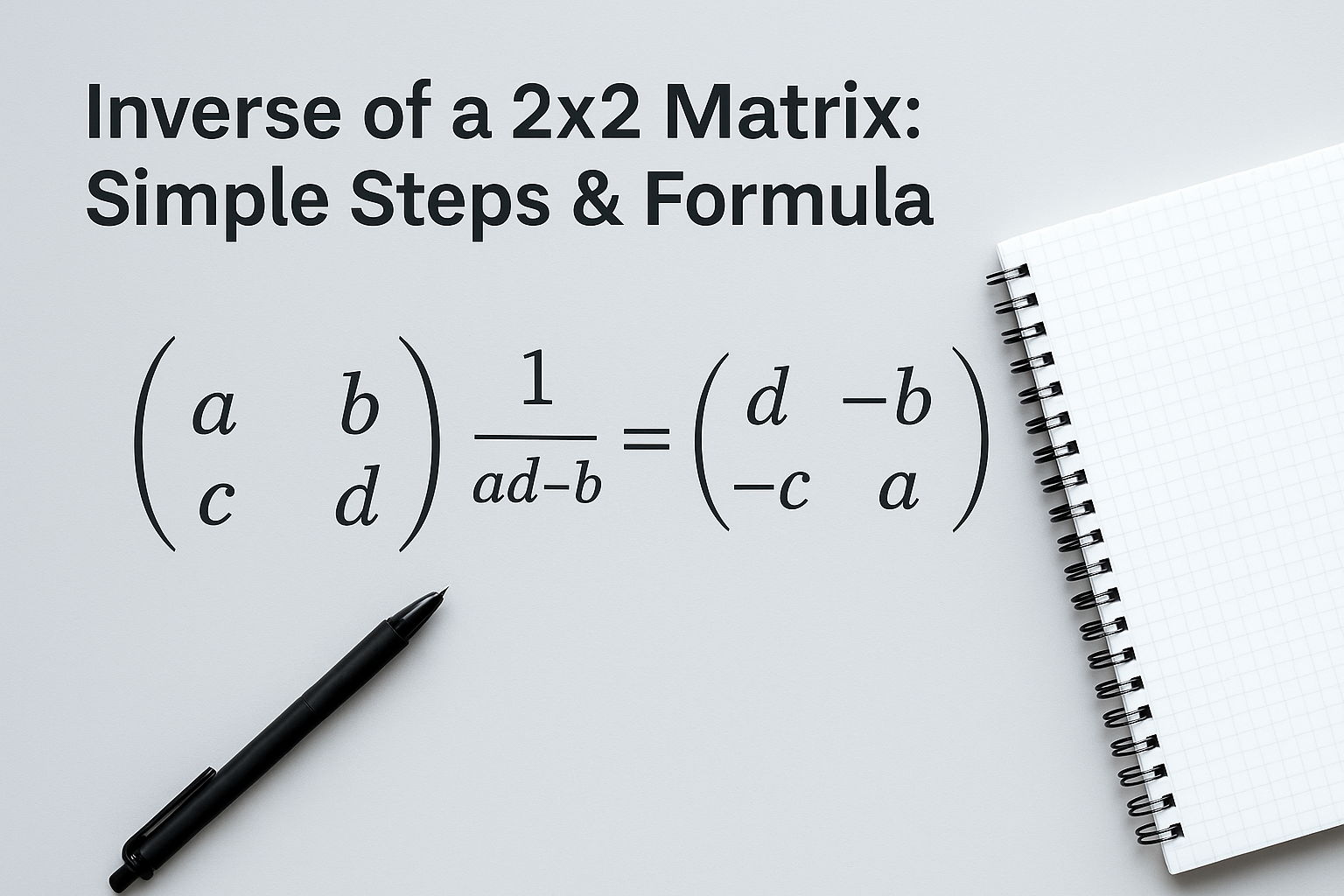
- The Inverse of a 2×2 Matrix Formula
- Worked Example: Finding the Inverse of a 2×2 Matrix Step by Step
- Common Mistakes When Finding the Inverse of a 2×2 Matrix
- Pro Tips for Quick Calculation of the Inverse of a 2×2 Matrix
- Pros and Cons of the Formula Method for the Inverse of a 2×2 Matrix
- Real-World Application: Solving Systems with the Inverse of a 2×2 Matrix
- Frequently Asked Questions
🔑 Key Takeaways
- The inverse of a 2×2 matrix is defined only for matrices with a non‑zero determinant.
- The formula swaps a and d, negates b and c, then multiplies by the reciprocal of the determinant.
- Always check the determinant first — dividing by zero is the most common error.
- Use the inverse to solve linear systems and for division in matrix algebra.
- Practice with integer and fractional determinants to build confidence.
What Is the Inverse of a 2×2 Matrix?
In linear algebra, the inverse of a 2×2 matrix is the matrix that, when multiplied by the original, yields the identity matrix. If A is the original, then its inverse, written A⁻¹, satisfies:
$$A \cdot A^{-1} = A^{-1} \cdot A = I$$
where I is the 2×2 identity matrix. Finding the inverse of a 2×2 matrix is a fundamental skill used in solving systems of linear equations, computer graphics, and data science. For a broader introduction to matrix operations, see our complete guide to mastering inverse matrices.
Every invertible matrix has exactly one inverse. The formula for a 2×2 matrix is particularly compact and easy to memorise. It also serves as a building block for understanding inverses of larger matrices. For further reading, the Wolfram MathWorld article on matrix inverses provides an excellent reference.
Condition for the Inverse of a 2×2 Matrix: Non‑Zero Determinant
Not every 2×2 matrix has an inverse. The inverse of a 2×2 matrix exists only if its determinant is not zero. The determinant of a 2×2 matrix $$A = \begin{bmatrix} a & b \\ c & d \end{bmatrix}$$ is computed as:
$$\det(A) = ad – bc$$
If \(\det(A) = 0\), the matrix is called singular and no inverse exists. For instance, the matrix $$\begin{bmatrix} 2 & 4 \\ 1 & 2 \end{bmatrix}$$ has determinant \(2\cdot2 – 4\cdot1 = 4-4=0\), so it has no inverse. Understanding the determinant is crucial before attempting to calculate any inverse. For more on determinants, read our article on the determinant of a matrix (applicable to 2×2 as well).
Why does a zero determinant prevent invertibility? Geometrically, the matrix maps the plane to a line or a point (compressing the area to zero). There is no way to “undo” that collapse, so the transformation is not invertible. This insight reinforces why every computation must begin with the determinant check.
The Inverse of a 2×2 Matrix Formula
Once you confirm the determinant is non‑zero, apply the standard formula for the inverse of a 2×2 matrix:
$$A^{-1} = \frac{1}{\det(A)} \begin{bmatrix} d & -b \\ -c & a \end{bmatrix}$$
Steps:
- Compute the determinant: \(\det(A) = ad – bc\).
- Swap the elements on the main diagonal: \(a\) and \(d\) trade places.
- Change the signs of the off‑diagonals: \(b\) becomes \(-b\), \(c\) becomes \(-c\).
- Multiply every entry by \(1 / \det(A)\).
This systematic procedure works for every invertible 2×2 matrix. Memorising the pattern “swap, negate, divide” makes the calculation quick and accurate.
Worked Example: Finding the Inverse of a 2×2 Matrix Step by Step
Let’s calculate the inverse of a 2×2 matrix with real numbers. Consider:
$$A = \begin{bmatrix} 4 & 7 \\ 2 & 6 \end{bmatrix}$$
🧪 Worked example
Step 1 – Compute the determinant
\(\det(A) = (4)(6) – (7)(2) = 24 – 14 = 10\). A non‑zero value means the inverse exists.
Step 2 – Apply the formula
Swap \(a=4\) and \(d=6\), resulting in \(\begin{bmatrix} 6 & … \\ … & 4 \end{bmatrix}\). Negate \(b=7\) to \(-7\) and \(c=2\) to \(-2\): \(\begin{bmatrix} 6 & -7 \\ -2 & 4 \end{bmatrix}\).
Step 3 – Divide by the determinant
Multiply each entry by \(1/10\):
$$A^{-1} = \frac{1}{10} \begin{bmatrix} 6 & -7 \\ -2 & 4 \end{bmatrix} = \begin{bmatrix} 0.6 & -0.7 \\ -0.2 & 0.4 \end{bmatrix}$$
Verify: Multiply \(A \cdot A^{-1}\) to confirm you get the identity matrix: $$\begin{bmatrix} 4 & 7 \\ 2 & 6 \end{bmatrix} \begin{bmatrix} 0.6 & -0.7 \\ -0.2 & 0.4 \end{bmatrix} = \begin{bmatrix} 1 & 0 \\ 0 & 1 \end{bmatrix}$$
This example shows that the process is straightforward once you master the three‑step procedure. Practice with different matrices to build speed.
Let’s try another example where the determinant is a fraction. Consider: $$B = \begin{bmatrix} 3 & 1 \\ 2 & 1 \end{bmatrix}$$ The determinant is \(3\cdot1 – 1\cdot2 = 3-2 = 1\). Because \(\det(B)=1\), the inverse is simply the swapped-and‑negated matrix without scaling: $$B^{-1} = \begin{bmatrix} 1 & -1 \\ -2 & 3 \end{bmatrix}$$. This is a special case: when the determinant is 1, the inverse consists only of the swap‑negate operation.
For a fractional determinant, say $$C = \begin{bmatrix} 1 & 2 \\ 3 & 5 \end{bmatrix}$$, \(\det(C)=5-6=-1\). Then the inverse is \(-1\) times the swapped‑negated matrix: $$C^{-1} = \begin{bmatrix} -5 & 2 \\ 3 & -1 \end{bmatrix}$$. Handling negative determinants is no different — the sign carries into every entry.
Common Mistakes When Finding the Inverse of a 2×2 Matrix
Even experienced students stumble on a few pitfalls when computing the inverse of a 2×2 matrix. Here are the most frequent errors:
- Incorrect sign changes: The off‑diagonals must become negative. If \(b\) is already negative, it becomes positive. Double‑check each sign. For instance, with matrix $$D = \begin{bmatrix} 2 & -3 \\ 4 & 5 \end{bmatrix}$$, the off‑diagonal \(-3\) becomes \(3\) after negation.
- Dividing by a zero determinant: If \(\det(A)=0\), the matrix is singular — stop. Do not attempt a division that is undefined.
- Mistaking the order of multiplication: The inverse must be multiplied on the correct side. For square matrices, left and right multiplication both yield the identity, but for non‑square matrices the side matters.
- Rounding prematurely: When the determinant is a fraction, keep all numbers as fractions until the final result. Decimal approximations can introduce errors.
Being aware of these mistakes ensures your calculation of the inverse of a 2×2 matrix is accurate every time.
Pro Tips for Quick Calculation of the Inverse of a 2×2 Matrix
To speed up finding the inverse of a 2×2 matrix, follow these best practices:
- Check the determinant as your first move. If it’s zero, you’re done — save time. If it’s 1 or -1, the inverse is immediate.
- Use mental math for small integers. Practice the “swap, negate, divide” pattern until it becomes automatic.
- Keep fractions rational. If the determinant divides unevenly, express the inverse using fractions (e.g., \(\begin{bmatrix} 2/3 & -1/3 \\ 1/2 & 1/6 \end{bmatrix}\)) rather than decimals.
- Verify by multiplication. Multiply your result by the original matrix. If you don’t get the identity, an error is present.
These tips reduce errors and make computing the inverse of a 2×2 matrix a 30‑second task. For related techniques, see our article on eigenvalues of a 2×2 matrix.
Pros and Cons of the Formula Method for the Inverse of a 2×2 Matrix
✅ Pros
- Simple three‑step procedure — easy to memorise.
- Works for any 2×2 matrix with a non‑zero determinant.
- Involves only basic arithmetic (addition, subtraction, multiplication, division).
- Widely taught and used in textbooks and exams.
❌ Cons
- Only works for 2×2 matrices — larger matrices require more complex methods.
- Risk of sign errors if you rush the “negate” step.
- Does not reveal deeper properties (e.g., invertibility conditions beyond determinant).
- Requires careful handling of fractions when determinant is not an integer.
The formula for the inverse of a 2×2 matrix is a perfect blend of simplicity and power for 2×2 systems. For larger matrices, you’ll need Gaussian elimination or adjugate methods, but the 2×2 formula remains a building block.
Real-World Application: Solving Systems with the Inverse of a 2×2 Matrix
One of the most practical uses of the inverse of a 2×2 matrix is solving a system of two linear equations. Suppose you have:
\begin{align*} 2x + 3y &= 7 \\ 4x + 5y &= 11 \end{align*}
Write the system as a matrix equation \(AX = B\), where $$A = \begin{bmatrix} 2 & 3 \\ 4 & 5 \end{bmatrix},\quad X = \begin{bmatrix} x \\ y \end{bmatrix},\quad B = \begin{bmatrix} 7 \\ 11 \end{bmatrix}.$$
If we can find the inverse of a 2×2 matrix \(A\), then the solution is \(X = A^{-1}B\). First compute \(\det(A)=2\cdot5 – 3\cdot4 = 10-12=-2\). The inverse is: $$A^{-1} = \frac{1}{-2} \begin{bmatrix} 5 & -3 \\ -4 & 2 \end{bmatrix} = \begin{bmatrix} -2.5 & 1.5 \\ 2 & -1 \end{bmatrix}.$$
Now multiply by \(B\): $$X = \begin{bmatrix} -2.5 & 1.5 \\ 2 & -1 \end{bmatrix} \begin{bmatrix} 7 \\ 11 \end{bmatrix} = \begin{bmatrix} (-2.5)(7)+(1.5)(11) \\ (2)(7)+(-1)(11) \end{bmatrix} = \begin{bmatrix} -17.5+16.5 \\ 14-11 \end{bmatrix} = \begin{bmatrix} -1 \\ 3 \end{bmatrix}.$$
Thus \(x = -1\) and \(y = 3\). This method is elegant and works whenever the coefficient matrix is invertible. It demonstrates why mastering the inverse of a 2×2 matrix is essential for anyone working with linear algebra.
Frequently Asked Questions
What is the inverse of a 2×2 matrix?+
The inverse of a 2×2 matrix A is the matrix A⁻¹ such that A × A⁻¹ = I (the 2×2 identity matrix). It exists only if the determinant is non‑zero.
How do you find the inverse of a 2×2 matrix?+
Use the formula: swap the diagonal entries a and d, change the signs of b and c, then multiply by 1/determinant. Precisely, A⁻¹ = (1/det(A)) [[d, -b], [-c, a]].
What happens if the determinant of a 2×2 matrix is zero?+
If the determinant is zero, the matrix is singular and has no inverse. The formula would require division by zero, which is undefined.
Can you give an example of calculating the inverse of a 2×2 matrix?+
For A = [[4,7],[2,6]], det(A)=10. Then A⁻¹ = (1/10)[[6, -7],[-2, 4]] = [[0.6, -0.7],[-0.2, 0.4]].
What are common mistakes when finding the inverse of a 2×2 matrix?+
Common mistakes include forgetting to swap the diagonal entries, incorrect sign changes on off‑diagonals, dividing by a zero determinant, and rounding fractions too early.