7 Essential Types of Vectors Every ML Practitioner Should Know
Understanding the types of vectors is fundamental for anyone working with machine learning, physics, or data science. This guide is designed to help ML practitioners master the core vector categories—zero, unit, position, free, bound, parallel, and orthogonal. Whether you’re normalizing features, computing distances, or analyzing linear dependencies, knowing which vector variety you’re dealing with can save hours of debugging and prevent subtle errors. Here, we break down the seven most important types of vectors you’ll encounter in practice. In this article, we’ll explore these seven key vector categories every ML practitioner needs to know.
What Are the Main Types of Vectors? Quick Answer
🔑 Key Takeaways
- Mistaking a free vector for a bound vector is a common source of errors in physics simulations and graphics.
- Unit vectors are the workhorses of data normalization—they scale features without changing direction.
- The zero vector is the additive identity; any vector plus zero vector equals itself.
- Orthogonal vectors are central to dimensionality reduction (PCA) and feature engineering.
- Parallel vectors help in checking linear dependence, a concept explained fully in our guide on linear dependence.
- For a deeper dive, see the Wikipedia article on vectors.
Table of Contents
- Zero Vector
- Unit Vector
- Position Vector
- Free Vector vs. Bound Vector
- Parallel Vectors
- Orthogonal Vectors
- Beyond the Basics
- At a Glance Comparison
- Worked Example
- Common Mistakes
1. Zero Vector — The Silent Constant
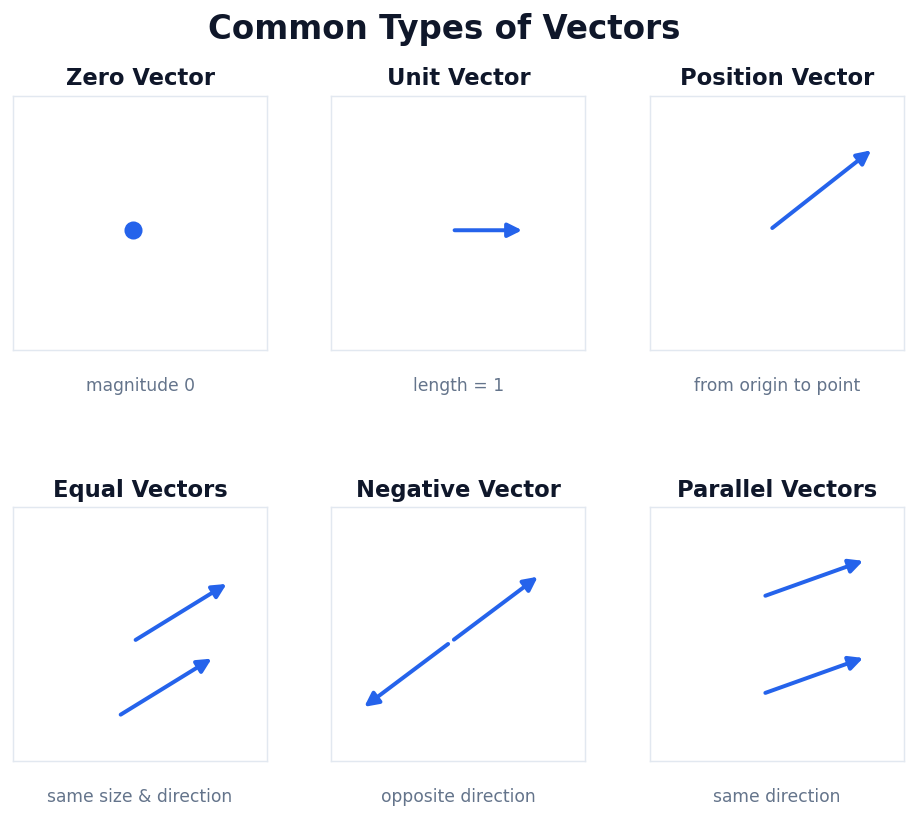
The zero vector, often denoted $\mathbf{0}$ or $\vec{0}$, has all components equal to zero. It has zero magnitude and no direction. You’ll encounter this type of vector when a system of equations has a trivial solution or when initializing neural network biases. Among all vector categories, the zero vector is the simplest. It is a fundamental vector kind in linear algebra. For example, in a linear regression model $\mathbf{y} = X\mathbf{w} + \mathbf{b}$, the bias vector $\mathbf{b}$ is often initialized to the zero vector before training.
In machine learning, the zero vector appears as the intercept term in linear models or as a placeholder for missing dimensions. It’s the additive identity: $\vec{v} + \mathbf{0} = \vec{v}$. Knowing this vector type helps avoid silent bugs in code. An edge case: when normalizing data, dividing by the zero vector is undefined—so always check for zero vectors before scaling.
2. Unit Vector — The Direction Keeper
A unit vector has a magnitude of exactly 1. It points in a specific direction but has no scale. To obtain a unit vector from any vector $\vec{v}$, divide by its norm: $\hat{v} = \frac{\vec{v}}{\|\vec{v}\|}$. Unit vectors are among the most widely used vector types in data preprocessing. This operation is critical for data normalization in ML pipelines. They are a versatile vector kind used extensively in machine learning. For instance, in k-means clustering, features are often scaled to unit length to prevent Euclidean distance from being dominated by wide-range variables.
We have a dedicated resource on unit vectors: 7 key concepts for machine learning that dives deeper into their computational role. The unit vector is a core vector type for many ML algorithms.
3. Position Vector — Anchoring Points in Space
A position vector is fixed at the origin and points to a specific location in the coordinate system. In machine learning, each data point is a position vector in the feature space. For example, a vector $\vec{p} = (x_1, x_2, \ldots, x_n)$ represents the coordinates of one sample. This vector type bridges geometry and data. Consider a dataset of house prices: every house can be represented as a position vector whose components are square footage, number of bedrooms, and age.
Position vectors are the default way we represent data in matrix form. They are a specific vector type that combines magnitude and direction with a definite starting point. Understanding this category is essential for data preprocessing. When building a linear model $\hat{y} = \mathbf{w} \cdot \mathbf{x} + b$, the input $\mathbf{x}$ is a position vector in feature space.
“A position vector turns raw numbers into a geometric story—every dataset is a collection of points in space.”
4. Free Vector vs. Bound Vector — The Where Matters
This distinction is crucial in physics and graphics, but also appears in ML when dealing with gradients or forces. A free vector can be placed anywhere; only its direction and length matter. A bound vector has a specific point of application, like a force acting on a joint in robotics. Both are important vector categories to distinguish. Understanding these two kinds is critical for physics simulations in reinforcement learning. For example, a velocity vector in a simulated robot is free—it applies to the whole body—while a contact force is bound to a specific point.
✅ Free Vector
- No fixed location
- Used for velocity, acceleration
- Additive property holds anywhere
❌ Bound Vector
- Fixed point of application
- Used for forces, torques
- Cannot be translated freely without changing the system
In practice, most ML algorithms treat feature vectors as free vectors—you can shift them without changing their meaning. But when simulating physical systems (e.g., reinforcement learning in robotics), bound vectors become essential. Mastering these two vector categories prevents subtle bugs. For instance, in gradient descent, the gradient is a free vector indicating the direction of steepest ascent—it doesn’t matter where you apply it.
5. Parallel Vectors — Same Direction, Any Scale
Two vectors are parallel if one is a scalar multiple of the other: $\vec{v} = k \vec{u}$ for some scalar $k$. If $k > 0$, they point in the same direction; if $k < 0$, they point opposite. Parallel vectors are the basis for checking linear dependence—a topic central to understanding vector spaces. This vector relationship is fundamental in linear algebra. Recognizing parallel vector types is key to avoiding errors in code. For example, in linear regression, if two feature vectors are parallel, they are perfectly correlated and cause multicollinearity issues.
For a deeper look into how parallel and other relationships define vector dependencies, check our guide on linear dependence of vectors. Recognizing parallel vector categories is key to avoiding errors in code, such as when performing Singular Value Decomposition (SVD) on a dataset with duplicated features.
6. Orthogonal Vectors — The Right Angle
Two vectors are orthogonal if their dot product is zero: $\vec{v} \cdot \vec{u} = 0$. In 2D or 3D, this means they are perpendicular. Orthogonality is central to PCA, feature selection, and the concept of independence. For example, the standard basis vectors $\mathbf{i}, \mathbf{j}, \mathbf{k}$ are mutually orthogonal. Orthogonal vectors are the key vector types used in PCA. This vector relationship simplifies many ML computations. When features are orthogonal, the covariance matrix becomes diagonal, which simplifies interpretation and regularization.
Orthogonal vectors are also the ‘cleanest way’ to represent data because they carry no redundant information. This is why PCA finds orthogonal principal components. Knowing this vector type helps you design better feature spaces. For more on vector spaces, refer to the MIT Linear Algebra lectures. An edge case: the zero vector is orthogonal to every vector, so be careful when using orthogonality to detect redundancy—zero vectors won’t cause issues but can indicate missing data.
7. Beyond the Basics: Vector Norms and Multiplying Vectors
Once you know the vector varieties, you need to know how to measure and combine them. The magnitude of a vector is given by its norm—see our full article on vector norms for the common L1, L2, and L∞ norms. Multiplying vectors can be done via dot product, cross product, or element-wise multiplication—each has a different geometric meaning explored in the guide on multiplying vectors: 5 essential methods. Understanding these operations on the vector categories is the next step. For instance, the dot product of two unit vectors equals the cosine of the angle between them, which is the basis for cosine similarity in recommendation systems.
At a Glance: Comparing the Types of Vectors
| Type of Vector | Key Property | Common Mistake |
|---|---|---|
| Zero Vector | All components zero, no direction | Forgetting it’s orthogonal to everything |
| Unit Vector | Magnitude = 1 | Dividing by zero vector to get unit |
| Position Vector | Fixed at origin, points to location | Confusing free vectors with position vectors |
| Free Vector | No fixed location | Applying force without point of application |
| Bound Vector | Fixed point of application | Treating it as free in physics simulations |
| Parallel Vectors | Scalar multiples of each other | Assuming they must be in same line in high dimensions |
| Orthogonal Vectors | Dot product = 0 | Thinking zero vector is not orthogonal |
Worked Example: Identifying Types of Vectors
🧪 Worked example
Solution:
- $\vec{a}$: position vector (points to (3,0,0)). Also parallel to $\vec{i}$. Not a unit vector (magnitude 3).
- $\vec{b}$: free or position vector. Not unit (magnitude $\sqrt{14}$).
- $\vec{c}$: zero vector (all components zero).
- $\vec{d}$: parallel to $\vec{a}$ (scalar multiple: 2 * $\vec{a}$). Also position vector.
- $\vec{e}$: unit vector (magnitude 1) derived from $\vec{b}$.
- $\vec{f}$: unit vector along y-axis, orthogonal to $\vec{a}$ and $\vec{d}$.
Common Mistakes to Avoid
- Assuming all vectors are free: In physics-based models, bound vectors must be applied at the correct point, or the simulation will be incorrect.
- Forgetting that the zero vector is orthogonal: When computing dot products for orthogonality checks, zero vectors will always return zero, which can mislead redundancy analysis.
- Dividing by a zero vector: When normalizing, always check for zero magnitude to avoid division by zero.
- Confusing position vectors with free vectors: A position vector is anchored to the origin; shifting it changes the point it represents, whereas a free vector can be translated arbitrarily.
- Misidentifying parallel vectors in high dimensions: Two vectors are parallel if one is a scalar multiple of the other, even in 100 dimensions—the line they lie on is still one-dimensional.
Keep Reading
📖 Keep reading: Related guides from ML for Beginners
Frequently Asked Questions
Mastering these seven vector types gives you a solid foundation for linear algebra in machine learning. Each vector variety has unique properties and common pitfalls—knowing them will save you time and prevent bugs. For a quick refresher, refer back to the comparison table and worked example.