In linear algebra, linearly independent vectors are the foundation of vector spaces and basis sets. This guide explains what they are, how to spot them, why they matter in machine learning, and gives you step‑by‑step methods to test any set of vectors — with real world examples.
🔑 Key Takeaways
- Linearly independent vectors cannot be expressed as a combination of each other.
- The determinant test works only for square matrices; row reduction works for any set.
- In ML, independence avoids redundant features and ensures invertible matrices (e.g., in linear regression).
- A set containing the zero vector is automatically linearly dependent.
- Basis vectors are always linearly independent by definition.
What Are Linearly Independent Vectors?
Imagine you have a few arrows pointing in different directions. If you can stretch, shrink, or flip an arrow but never create a new direction that isn’t already covered by the others, then your arrows (vectors) are linearly dependent. But if each arrow adds a genuinely new dimension — one that the others cannot reproduce — they are linearly independent vectors.
Formally, a set of vectors $\{\mathbf{v}_1, \mathbf{v}_2, \dots, \mathbf{v}_k\}$ is linearly independent if the only solution to
$$c_1\mathbf{v}_1 + c_2\mathbf{v}_2 + \dots + c_k\mathbf{v}_k = \mathbf{0}$$
is $c_1 = c_2 = \dots = c_k = 0$. Any nonzero solution implies dependence.
Geometric Intuition Behind Linearly Independent Vectors
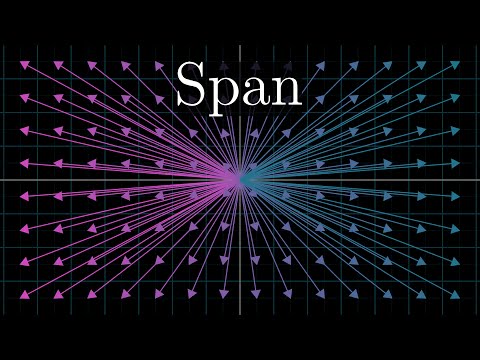
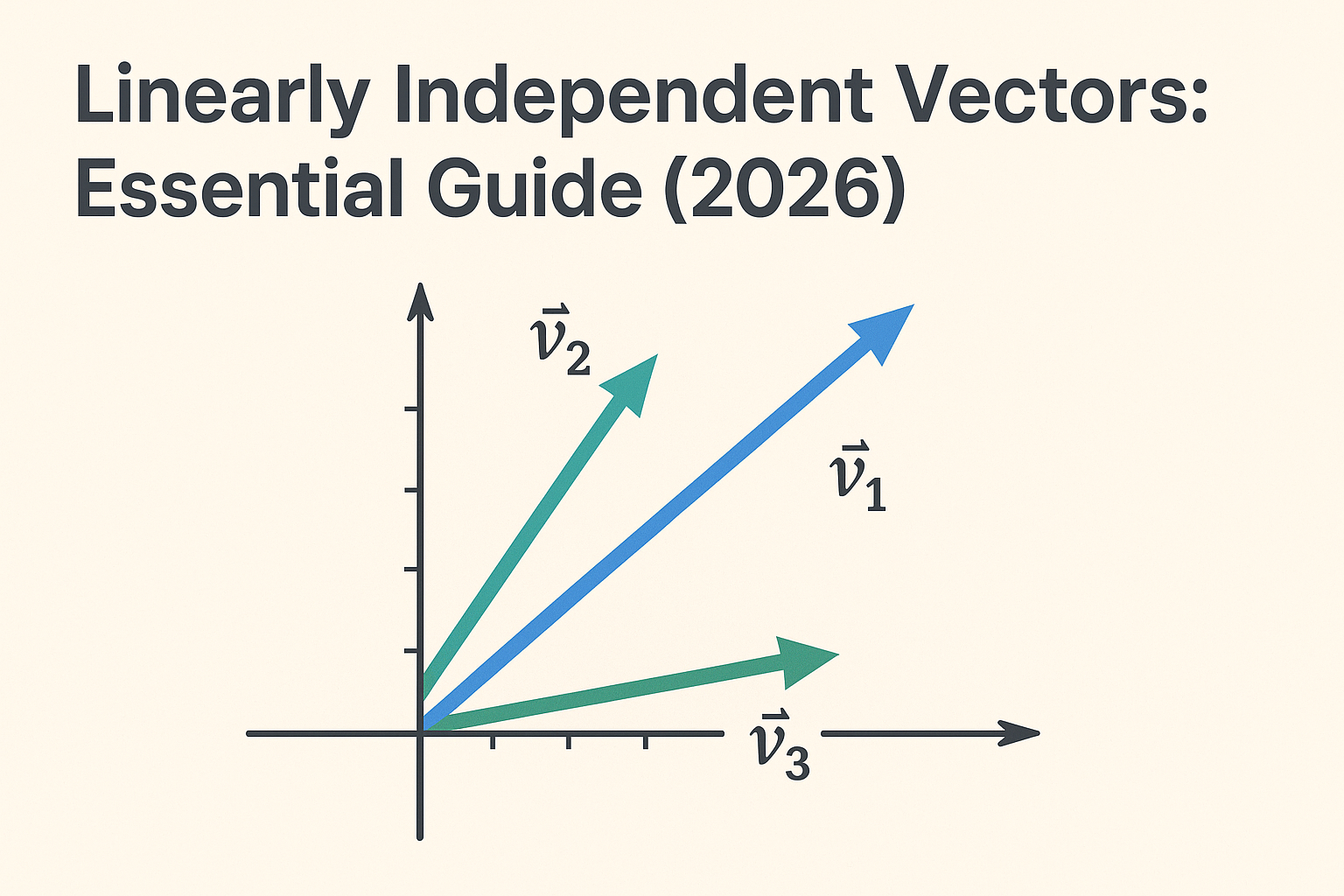
Picture a 2D plane. Any two vectors that point in different directions (not along the same line) are linearly independent. Together they span the entire plane. Add a third vector lying in the same plane — it’s now dependent because the first two already cover every direction the third can offer.
In 3D, three vectors are independent if they don’t lie in the same plane. For example, $\mathbf{i} = (1,0,0)$, $\mathbf{j} = (0,1,0)$, and $\mathbf{k} = (0,0,1)$ are independent because they point along three perpendicular axes. A fourth vector in 3D will always be dependent — you can never have more independent vectors than the dimension of the space.
“Linearly independent vectors are the minimal ingredients that span a space with no redundancy.”
How to Check if Vectors Are Linearly Independent Vectors
There are three reliable methods. Use the one that fits your situation best.
1. The Determinant Test (Square Matrices Only)
If you have $n$ vectors in $\mathbb{R}^n$, form an $n \times n$ matrix $A$ where each column is one vector. Compute $\det(A)$. If $\det(A) \neq 0$, the columns are linearly independent. If $\det(A) = 0$, they are dependent.
Example: Check if $\mathbf{v}_1 = (1,2)$ and $\mathbf{v}_2 = (3,4)$ are linearly independent.
$$A = \begin{bmatrix} 1 & 3 \\ 2 & 4 \end{bmatrix}, \quad \det(A) = 1\cdot4 – 3\cdot2 = -2 \neq 0$$ So they are linearly independent.
Example (dependent): $\mathbf{v}_1 = (1,2)$, $\mathbf{v}_2 = (2,4)$. Then $\det(A) = 1\cdot4 – 2\cdot2 = 0$, so they are dependent.
2. Row Reduction (Works for Any Set)
Form a matrix with the vectors as rows or columns, then reduce to row‑echelon form (Gaussian elimination). If every column has a leading 1 (a pivot), the vectors are linearly independent. If any column lacks a pivot, dependence exists.
Write each vector as a column of a matrix $M$.
Use elementary row operations to reach reduced row‑echelon form.
If every column has a pivot, the original vectors are linearly independent. If not, they are dependent.
🧪 Worked example
Form $M = \begin{bmatrix} 1 & 0 & 4 \\ 2 & 1 & 5 \\ 0 & 3 & 6 \end{bmatrix}$. Row reduce:
$R2 \to R2 – 2R1$: $\begin{bmatrix}1&0&4\\0&1&-3\\0&3&6\end{bmatrix}$
$R3 \to R3 – 3R2$: $\begin{bmatrix}1&0&4\\0&1&-3\\0&0&15\end{bmatrix}$
All three columns have pivots → vectors are linearly independent.
3. The Linear Combination Definition
You can also solve the equation $c_1\mathbf{v}_1 + \dots + c_k\mathbf{v}_k = \mathbf{0}$ directly. Set up a system of linear equations. If the only solution is all $c_i = 0$, the vectors are linearly independent. This method is equivalent to row reduction but helps build intuition.
Why Linearly Independent Vectors Matter in Machine Learning
In machine learning, data is often represented as vectors — rows of features. If your feature matrix has columns that are linearly dependent, you get nasty problems: the normal equation $(X^TX)^{-1}X^Ty$ fails because $X^TX$ becomes non‑invertible (singular). This is called multicollinearity.
For example, in linear regression, if one feature is roughly a combination of others, the model coefficients become unstable and hard to interpret. Ensuring your feature vectors are linearly independent vectors is a first step toward stable, interpretable models.
Beyond regression, independent vectors form bases for spaces like the kernel of a PCA transformation, the columns of a weight matrix in a neural network, and the embedding vectors in natural language processing. Without linear independence, you lose rank and thus representation power.
Relation to Other Linear Algebra Concepts
Linearly independent vectors sit at the heart of many core ideas:
- Basis: A basis is a set of linearly independent vectors that span the whole space. For $\mathbb{R}^n$, you need exactly $n$ independent vectors. Read more about how unit vectors form a basis.
- Linear dependence: The opposite concept. When vectors are dependent, at least one is redundant. Our guide on linear dependence of vectors covers this in depth.
- Identity matrix: Its columns are the canonical example of linearly independent vectors. The identity matrix properties make it a perfect reference.
You might also want to explore orthogonal vectors, which are always linearly independent (unless one is zero), and how they simplify computations.
| Property | Linearly Independent Set | Linearly Dependent Set |
|---|---|---|
| Number of vectors vs. dimension | At most equal to the dimension of the space | Can be larger |
| Span | Has full rank; spans a subspace of dimension equal to number of vectors | Span has dimension less than number of vectors |
| Zero vector present? | Impossible (set becomes dependent) | Automatically dependent |
Common Mistakes When Working With Linearly Independent Vectors
Another mistake: forgetting to subtract scalar multiples correctly when using the determinant test. A small arithmetic error can flip the conclusion. Always double‑check your row operations.
A third error: thinking that any set of vectors with a zero vector is still independent. It never is — because you can write $0 = 1 \cdot \mathbf{0} + 0 \cdot \text{others}$, so the coefficients aren’t all zero.
✅ Pros of checking independence
- Avoids singular matrices in regression
- Ensures basis is minimal
- Helps with feature selection
❌ Cons of ignoring dependence
- Non‑invertible matrices
- Unstable coefficients
- Reduced model interpretability
Practical Exercises to Test Your Understanding of Linearly Independent Vectors
Try these yourself before checking the answers.
Exercise 1: Are $\mathbf{a} = (1, -1, 2)$, $\mathbf{b} = (2, 1, 0)$, $\mathbf{c} = (3, 0, 2)$ linearly independent?
Exercise 2: In $\mathbb{R}^2$, how many linearly independent vectors can you have at most?
Exercise 3: Does a set of three vectors in $\mathbb{R}^2$ guarantee dependence?
For more hands‑on practice, check out the linear algebra for machine learning guide which includes a full section on independence.