Limit Calculator lim
Find the limit of a function as x approaches a value (or infinity), from either side.
Show working (LaTeX)
Type infinity (or inf) for x→∞. Use * for multiply and ^ for powers. Computed numerically.
This free limit calculator evaluates the limit of a function as x approaches any value — or infinity — from the left, the right or both sides, with the result shown step by step.
How to use the limit calculator
Type your function, the value x approaches and a direction, then press Find limit. The limit calculator evaluates the function as x gets arbitrarily close to the point and reports the left limit, the right limit and the two-sided limit. As a limit solver and limit of a function calculator, it handles removable holes, one-sided limits and limits at infinity.
What is a limit?
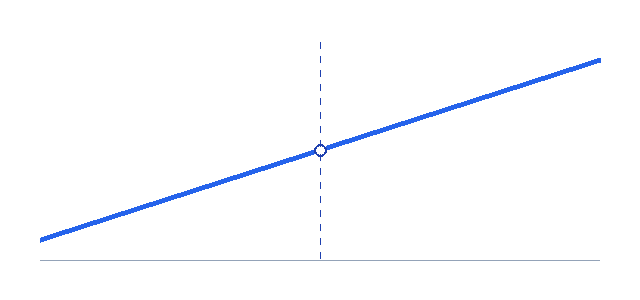
A limit is the value a function gets close to as the input approaches a certain point. It is the foundation of calculus — derivatives and integrals are both defined with limits. Start with our guide to what is a limit in calculus, or see the limit reference.
Limit notation
$$\lim_{x\to a} f(x)=L,\qquad \lim_{x\to a^-}f(x)\ \text{(left)},\qquad \lim_{x\to a^+}f(x)\ \text{(right)}$$The two-sided limit exists only when the left and right limits are equal.
How to find a limit step by step
- Try substituting the value directly into the function.
- If you get a number, that is the limit; if you get 0/0, simplify (factor or cancel) first.
- Check the left and right sides agree — or read it off the calculator above.
Worked example
Evaluate $\lim_{x\to 2}\frac{x^2-4}{x-2}$. Direct substitution gives 0/0, but factoring gives $\frac{(x-2)(x+2)}{x-2}=x+2$, so the limit is $2+2=4$.
One-sided limits and limits at infinity
A one-sided limit looks at the approach from only the left or right — useful at jumps and piecewise boundaries. A limit at infinity describes long-run behaviour; for example $\lim_{x\to\infty}\frac{1}{x}=0$. The limit calculator handles both: type infinity for the point, or pick a direction.
| Limit | Value |
|---|---|
| $\lim_{x\to 0}\frac{\sin x}{x}$ | 1 |
| $\lim_{x\to\infty}\frac{1}{x}$ | 0 |
| $\lim_{x\to 0^+}\ln x$ | $-\infty$ |
| $\lim_{x\to\infty}\left(1+\frac{1}{x}\right)^x$ | $e$ |
Why limits matter in machine learning
Limits underpin the calculus behind machine learning for beginners: the derivative is defined as a limit, and gradient descent depends on those derivatives. Continuity, built on limits, is what keeps a loss function smooth enough to optimise — see limits and continuity for ML.
🤖 ML insight
The derivative — the heart of training — is literally a limit: $f'(x)=\lim_{h\to0}\frac{f(x+h)-f(x)}{h}$.
Tips for tricky limits
If direct substitution gives a finite number, you are done — most polynomials and continuous functions are that easy. The interesting cases are indeterminate forms like 0/0 or ∞/∞, where you factor, rationalise, or apply L’Hôpital’s rule by differentiating the top and bottom.
Watch the sides separately near vertical asymptotes and piecewise breaks: if the left and right limits disagree, the two-sided limit does not exist even though each one-sided limit might. A numerical tool like the one above is a fast way to confirm your algebra and to spot when a limit blows up to infinity.
Frequently asked questions
What does this limit calculator do?
How do I enter a limit at infinity?
What does “does not exist” mean?
Can it handle 0/0?
Is the limit calculator free?
Limit calculator: summary
This limit calculator evaluates two-sided, one-sided and infinite limits with the working shown. Pair it with the derivative calculator and the integral calculator.