Table of Contents
- What is the Transpose of a 2×2 Matrix?
- How to Compute the Transpose of a 2×2 Matrix
- Worked Example with Real Numbers
- Key Properties of the Transpose of a 2×2 Matrix
- Where You’ll Use the Transpose of a 2×2 Matrix
- Common Mistakes When Taking the Transpose of a 2×2 Matrix
- Pros and Cons of Using the Transpose
- Frequently Asked Questions
Welcome to this focused guide on the transpose of a 2×2 matrix. Whether you’re a student brushing up on linear algebra or a professional applying matrix operations in machine learning, understanding this transformation is essential. The operation is often one of the first matrix transformations you learn, and it appears in nearly every branch of applied mathematics. In this article, we’ll go deep: you’ll see the exact formula, a concrete worked example, the properties that matter, and the most common mistakes to avoid. Let’s start.
🔑 Key Takeaways
- The transpose of a 2×2 matrix flips rows into columns: $M^T_{ij} = M_{ji}$.
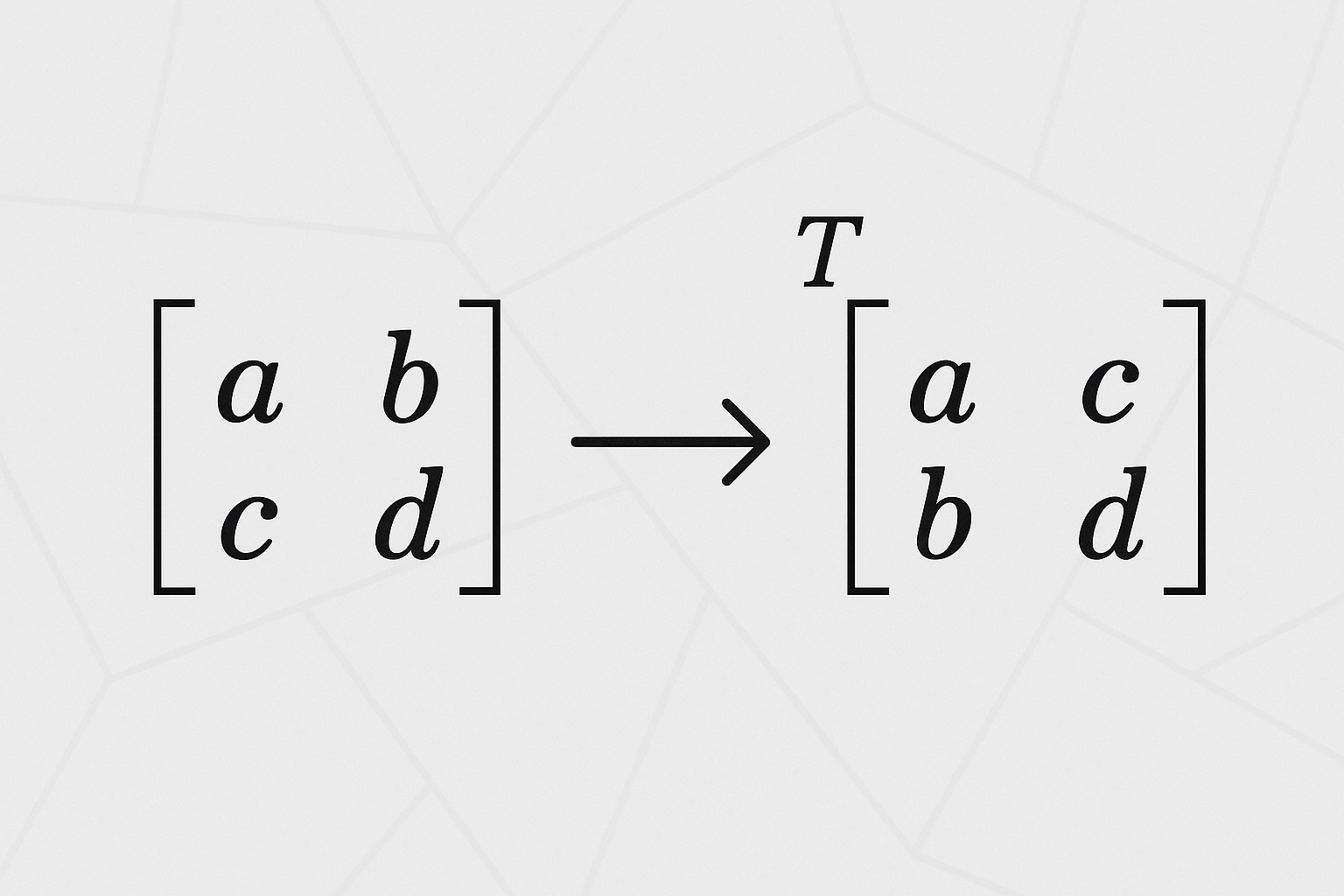
- For a matrix $\begin{bmatrix} a & b \\ c & d \end{bmatrix}$, the transpose is $\begin{bmatrix} a & c \\ b & d \end{bmatrix}$.
- The operation is its own inverse – the transpose of the transpose returns the original matrix.
- Transpose is essential for computing dot products, solving linear systems, and working with symmetric matrices.
What is the Transpose of a 2×2 Matrix?
In linear algebra, the transpose of a 2×2 matrix is a new matrix formed by swapping the rows and columns of the original. More formally, if we denote the original matrix as $M$, then its transpose $M^T$ satisfies $(M^T)_{ij} = M_{ji}$. For a 2×2 matrix, this means the entry at row 1, column 2 in $M$ becomes the entry at row 2, column 1 in $M^T$, and vice versa.
This operation is one of the simplest matrix transformations, yet it appears constantly in advanced topics like the inverse of a matrix calculation, where the transpose of the cofactor matrix (the adjugate) is required. If you’re studying larger matrices like 3×3, the same principle applies—only the dimensions change.
How to Compute the Transpose of a 2×2 Matrix
Computing the transpose of a 2×2 matrix is a two-step process:
- Write the first row of the original matrix as the first column of the transpose. That means the top-left entry stays in place; the top-right entry moves to the second row of the first column.
- Write the second row as the second column. The bottom-left entry moves to the top row of the second column; the bottom-right entry stays where it was (diagonal elements remain unchanged).
The result is always a 2×2 matrix. Let’s formalise it:
$$M = \begin{bmatrix} a & b \\ c & d \end{bmatrix} \quad \Rightarrow \quad M^T = \begin{bmatrix} a & c \\ b & d \end{bmatrix}$$Worked Example with Real Numbers
🧪 Worked example
Take the following 2×2 matrix:
$$A = \begin{bmatrix} 4 & 7 \\ 2 & 9 \end{bmatrix}$$Step 1: The first row is [4, 7]. Write it as the first column of $A^T$: top entry 4, below it 7.
Step 2: The second row is [2, 9]. Write it as the second column: top entry 2, below it 9.
Thus, the transpose of a 2×2 matrix $A$ is:
$$A^T = \begin{bmatrix} 4 & 2 \\ 7 & 9 \end{bmatrix}$$Notice the diagonal 4 and 9 stayed in place. The off-diagonal entries 7 and 2 swapped positions.
This simple example illustrates the entire process. The transpose of a 2×2 matrix is always a 2×2 matrix; its shape is preserved.
Key Properties of the Transpose of a 2×2 Matrix
Knowing the properties of the transpose of a 2×2 matrix helps you work more efficiently. Here are the most important ones:
- Involution: $(M^T)^T = M$. Taking the transpose twice returns the original. This holds for any matrix, including a 2×2 one.
- Addition: $(A + B)^T = A^T + B^T$. The transpose distributes over addition for two 2×2 matrices.
- Scalar multiplication: $(cA)^T = c(A^T)$ for any scalar $c$.
- Multiplication with a vector: For a column vector $v$, $(Av)^T = v^T A^T$ (though this involves a 2×2 matrix times a 2×1 vector).
- Determinant: $\det(A^T) = \det(A)$. The determinant of the transpose equals the determinant of $A$ itself.
“The transpose of a 2×2 matrix is its mirror image across the main diagonal — a simple flip that unlocks deeper matrix structure.”
Where You’ll Use the Transpose of a 2×2 Matrix
The transpose of a 2×2 matrix isn’t just a classroom exercise. It appears in:
- Covariance matrices: In statistics, a covariance matrix is symmetric — meaning it equals its own transpose. The transpose is used when deriving the covariance formula (see the Covariance Matrix Calculator for a practical tool).
- Linear transformations: The transpose of a rotation or reflection matrix gives the inverse transformation for orthogonal matrices.
- Machine learning: Gradient computations often require transposing weight matrices during backpropagation.
- Positive semi-definite matrices: A symmetric positive semi-definite matrix $A$ satisfies $A = A^T$. Understanding the transpose is the first step toward mastering Positive Semi-Definite Matrices.
Common Mistakes When Taking the Transpose of a 2×2 Matrix
Even though the transpose of a 2×2 matrix is simple, a few errors crop up regularly. Here are the most frequent:
Another common error is forgetting that the transpose of a 2×2 matrix is still a 2×2 matrix—some learners think the shape changes. It doesn’t. The dimensions remain the same because you’re swapping rows and columns within a square matrix.
Pros and Cons of Using the Transpose
✅ Pros
- Extremely simple to compute – can be done mentally.
- Preserves the determinant, so many matrix properties remain unchanged.
- Essential for symmetric matrix construction and matrix decompositions.
- Widely used in software (NumPy, MATLAB, etc.) with built-in functions.
❌ Cons
- Does not change the matrix in a way that directly solves linear systems (unlike inversion).
- Can be confused with the inverse by beginners, leading to errors.
- For non-square matrices, transpose changes dimensions – but for 2×2 that’s not an issue.
Master the 2×2 Matrix – Start Here
The transpose of a 2×2 matrix is just one operation in your linear algebra toolkit. To build a complete understanding, explore the full guide on the 2×2 matrix hub, where you’ll find interconnected articles covering everything from determinant to diagonalization. For a related deep dive, check out the negative covariance example in finance – a direct application of matrix transposition.
Remember, the transpose is not a difficult concept, but it is a gateway to more advanced topics like the inverse and eigenvalues. Practice it until it becomes second nature.
Frequently Asked Questions
What is the transpose of a 2×2 matrix?+
The transpose of a 2×2 matrix is obtained by swapping its rows and columns. If the original matrix has entries a, b in the first row and c, d in the second row, the transpose has entries a, c in the first row and b, d in the second row.
How do I calculate the transpose of a 2×2 matrix?+
For a 2×2 matrix M = [[a, b], [c, d]], the transpose M^T is [[a, c], [b, d]]. Simply move the first row to become the first column, and the second row to become the second column.
What does the transpose of a 2×2 matrix look like?+
The transpose of a 2×2 matrix remains a 2×2 matrix. For example, if M = [[1, 2], [3, 4]], then M^T = [[1, 3], [2, 4]]. The diagonal entries stay the same.
Why is the transpose of a 2×2 matrix important?+
The transpose is used in many areas of linear algebra, including computing dot products, solving linear systems, performing matrix decompositions, and defining symmetric matrices. In data science, it is essential for operations on covariance matrices and gradient calculations.
Can the transpose of a 2×2 matrix be equal to the original?+
Yes, if the 2×2 matrix is symmetric, meaning a = a, b = c, and d = d. For example, [[2, 5], [5, 3]] is symmetric, so its transpose equals itself.
📚 Keep reading
Ready to go further?
Master the full set of 2×2 matrix operations — from inverse to eigenvalues — on our hub page.
Explore the 2×2 matrix hub →