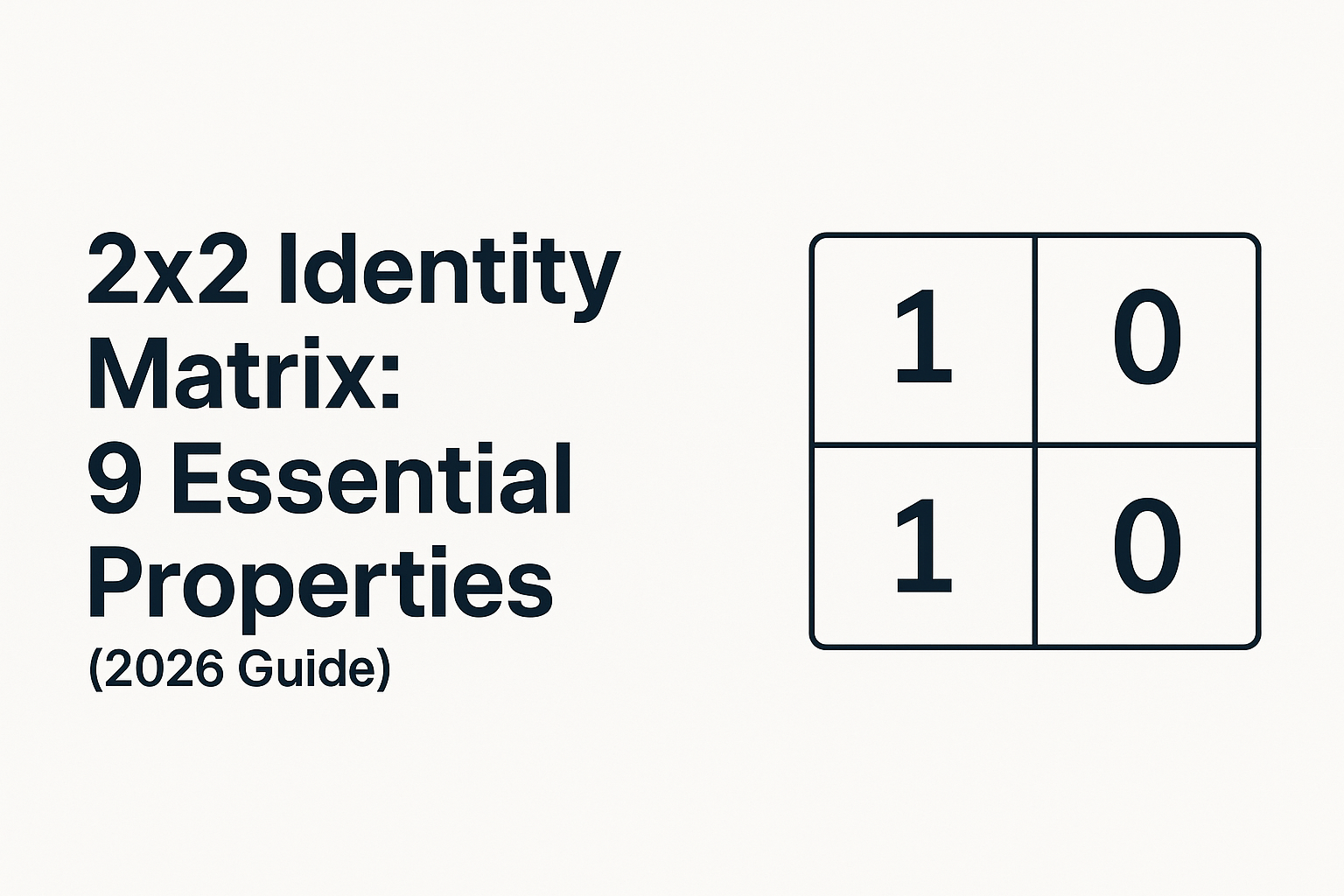
2×2 Identity Matrix: 9 Essential Properties (2026 Guide)

🔑 Key Takeaways
- The 2×2 identity matrix is $\begin{bmatrix}1 & 0\\0 & 1\end{bmatrix}$.
- It acts as the identity element for 2×2 matrix multiplication.
- Its determinant is 1, and it is its own inverse.
- It is symmetric, orthogonal, and has two identical eigenvalues (both 1).
- Every 2×2 matrix can be decomposed into a scalar part plus a traceless part using this identity.
📑 Table of Contents
What Is the 2×2 Identity Matrix?
The 2×2 identity matrix is the simplest square matrix of order 2. It contains 1’s on the main diagonal and 0’s everywhere else. It is denoted by $I_2$ or simply $I$ when the size is clear from context. Mathematically:
$$ I_2 = \begin{bmatrix} 1 & 0 \\ 0 & 1 \end{bmatrix} $$
This matrix is fundamental in linear algebra because it behaves like the number 1 in scalar arithmetic: multiplying any compatible matrix by this identity returns the original matrix. For a comprehensive overview of broader matrix topics, see the identity matrix guide.
The Defining Property
The core property of the 2×2 identity matrix is that for any 2×2 matrix $A$,
$$ A \cdot I = I \cdot A = A $$
where multiplication is standard matrix multiplication. This property makes $I$ the multiplicative identity in the ring of 2×2 matrices. Without it, many operations like finding inverses would be impossible.
This is analogous to the number 1 in real numbers: $a \cdot 1 = 1 \cdot a = a$. Similarly, this identity matrix does not change the matrix it multiplies.
9 Essential Properties of the 2×2 Identity Matrix
Below are nine essential properties of this identity matrix that every student and practitioner should know.
1. Multiplicative Identity
As stated, the 2×2 identity matrix leaves any 2×2 matrix unchanged under multiplication. This property is the defining characteristic of an identity element.
2. Its Own Inverse
Because $I \cdot I = I$, it is its own inverse: $I^{-1} = I$. This makes it an involutory matrix. In practical terms, if you multiply a matrix by $I$, you can undo the operation by multiplying by $I$ again.
3. Determinant Equals 1
The determinant of the identity matrix is:
$$ \det(I) = (1)(1) – (0)(0) = 1 $$
This is consistent with the property that the determinant of a product equals the product of determinants: $\det(A \cdot B) = \det(A)\det(B)$. For $A \cdot I = A$, we have $\det(A) = \det(A)\det(I)$, which forces $\det(I)=1$. For more on determinants, see the determinant of a matrix guide.
4. All Eigenvalues Are 1
The eigenvalues of the identity matrix are both 1. Solve $\det(I – \lambda I) = 0$:
$$ \det\left( \begin{bmatrix} 1-\lambda & 0 \\ 0 & 1-\lambda \end{bmatrix} \right) = (1-\lambda)^2 = 0 $$
Hence $\lambda = 1$ with algebraic multiplicity 2.
5. Symmetric and Orthogonal
The identity matrix is symmetric because $I^T = I$. It is also orthogonal because $I^T I = I$. This makes it a special case of a rotation matrix (rotates by 0 degrees).
6. Trace Equals 2
The trace of the identity is the sum of diagonal entries: $1+1 = 2$. This is also the sum of its eigenvalues.
7. Rank is 2 (Full Rank)
The identity matrix has rank 2 because its rows (and columns) are linearly independent. It is invertible and defines a one-to-one linear transformation.
8. Null Space Contains Only the Zero Vector
Since the identity matrix is invertible, its null space is $\{ \mathbf{0} \}$. The only vector that $I$ sends to zero is the zero vector.
9. Diagonalizable Over Any Field
The identity matrix is already diagonal. It is trivially diagonalizable by any invertible matrix $P$: $P I P^{-1} = I$. This property simplifies many proofs in linear algebra.
Worked Example: Multiplying by the 2×2 Identity Matrix
Let’s see this identity matrix in action. Take $A = \begin{bmatrix} 4 & -2 \\ 1 & 5 \end{bmatrix}$. Compute $A \cdot I$ and $I \cdot A$:
$$ A \cdot I = \begin{bmatrix} 4 & -2 \\ 1 & 5 \end{bmatrix} \begin{bmatrix} 1 & 0 \\ 0 & 1 \end{bmatrix} = \begin{bmatrix} 4\cdot1 + (-2)\cdot0 & 4\cdot0 + (-2)\cdot1 \\ 1\cdot1 + 5\cdot0 & 1\cdot0 + 5\cdot1 \end{bmatrix} = \begin{bmatrix} 4 & -2 \\ 1 & 5 \end{bmatrix} $$
Similarly, $I \cdot A = \begin{bmatrix} 1 & 0 \\ 0 & 1 \end{bmatrix} \begin{bmatrix} 4 & -2 \\ 1 & 5 \end{bmatrix} = \begin{bmatrix} 4 & -2 \\ 1 & 5 \end{bmatrix}$.
As expected, both products equal $A$. Notice that the identity essentially copies each element of $A$ unchanged. This property is why we can “factor out” the identity in equations like $A X = X$ to conclude $A = I$ if $X$ is invertible.
🧪 Worked example
Solution: $A \cdot I = \begin{bmatrix} 0 \cdot 1 + 6 \cdot 0 & 0 \cdot 0 + 6 \cdot 1 \\ -3 \cdot 1 + 2 \cdot 0 & -3 \cdot 0 + 2 \cdot 1 \end{bmatrix} = \begin{bmatrix} 0 & 6 \\ -3 & 2 \end{bmatrix} = A$. Similarly $I \cdot A = A$. The identity matrix leaves $A$ unchanged.
Visualizing the 2×2 Identity Matrix
The 2×2 identity matrix corresponds to the linear transformation that maps the standard basis vectors $\mathbf{e}_1 = (1,0)$ and $\mathbf{e}_2 = (0,1)$ to themselves. Geometrically, it is the identity transformation: every vector stays exactly where it is.
| Property | Value for 2×2 Identity Matrix |
|---|---|
| Determinant | 1 |
| Trace | 2 |
| Rank | 2 |
| Inverse | Itself |
| Eigenvalues | 1, 1 |
| Null Space | $\{ \mathbf{0} \}$ |
For a deeper look at matrix multiplication, check the matrix multiplication guide with solved examples.
Common Mistakes and Pro Tips
Even experienced practitioners sometimes slip up with identity matrices. Here are two frequent errors and how to avoid them:
- Confusing identity with a matrix that has ones only on one row or column. The 2×2 identity matrix must have both diagonal entries equal to 1. A matrix like $\begin{bmatrix}1 & 0\\0 & 0\end{bmatrix}$ is not an identity matrix because multiplying a general matrix by it does not return the original matrix.
- Assuming the identity matrix is the same as the zero matrix. The zero matrix has all entries 0; multiplying any matrix by zero yields zero, not the original.
Connections to Other Matrix Topics
The identity matrix plays a pivotal role in many matrix operations:
- Inverse: A 2×2 matrix $A$ is invertible exactly if there exists $B$ such that $A B = I$. The identity is the target product. See the inverse of a matrix guide.
- Determinant: The identity’s determinant is 1, which is the starting point for many determinant properties. Read more in the determinant of a matrix guide.
- Matrix multiplication: The identity is the neutral element for matrix multiplication. See the matrix multiplication calculator and examples.
For a broader perspective on identity matrices of all sizes, refer to the identity matrix overview. Additionally, you can explore the Wikipedia article on identity matrices for supplementary information.
📚 Keep reading
Pros and Cons of Using the Identity Matrix
✅ Pros
- Simplifies matrix equations.
- Essential for defining inverses.
- Forms the basis of linear transformations.
- Makes matrix calculations predictable.
❌ Cons
- Can be mistaken for other matrices (e.g., all-ones matrix).
- Does not represent any nontrivial transformation.
- Its simplicity sometimes hides deeper structure.
“The 2×2 identity matrix is the silent pivot of linear algebra: it appears everywhere but changes nothing.”
Frequently Asked Questions
What is the 2×2 identity matrix?
What is the determinant of the 2×2 identity matrix?
Is the 2×2 identity matrix symmetric?
What are the eigenvalues of the 2×2 identity matrix?
By mastering the 2×2 identity matrix, you build a strong foundation for linear algebra, matrix operations, and beyond.