Angle Between Vectors Calculator: Master Vector Calculations in 5 Easy Steps
Understanding how to calculate the angle between vectors is fundamental in mathematics, physics, and engineering. Whether you’re working with 2D or 3D vectors, our free angle between vectors calculator provides instant, accurate results with detailed step-by-step solutions.
What is the Angle Between Vectors?
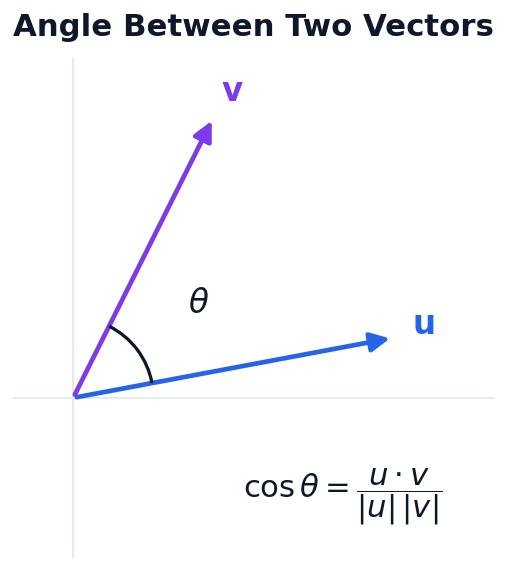
The angle between vectors represents the measure of rotation required to align one vector with another. This angle always ranges from 0° to 180° (or 0 to π radians) and provides crucial information about the relationship between two vectors in space.
When two vectors point in exactly the same direction, the angle between them is 0°. When they’re perpendicular (orthogonal), the angle is 90°. Vectors pointing in opposite directions form an angle of 180°.
Angle Between Vectors Formula
The most efficient method to find the angle between vectors uses the dot product formula. This mathematical approach works for vectors in any dimension.
Where:
- θ (theta) is the angle between vectors
- a · b represents the dot product of vectors a and b
- |a| is the magnitude (length) of vector a
- |b| is the magnitude (length) of vector b
To isolate θ, we apply the inverse cosine function:
How to Calculate Angle Between Vectors: 5 Simple Steps
Follow this systematic approach to calculate the angle between vectors accurately:
Step 1: Calculate the Dot Product
Multiply corresponding components and sum them. For vectors a = (a₁, a₂, a₃) and b = (b₁, b₂, b₃):
a · b = a₁b₁ + a₂b₂ + a₃b₃
Step 2: Find the Magnitude of Vector A
Calculate the length using the Pythagorean theorem:
|a| = √(a₁² + a₂² + a₃²)
Step 3: Find the Magnitude of Vector B
Similarly, calculate vector b’s magnitude:
|b| = √(b₁² + b₂² + b₃²)
Step 4: Apply the Cosine Formula
Divide the dot product by the product of magnitudes:
cos(θ) = (a · b) / (|a| × |b|)
Step 5: Calculate the Angle
Use the inverse cosine function to find θ:
θ = arccos(cos(θ))
The result will be in radians. To convert to degrees, multiply by 180/π ≈ 57.2958.
Calculating Angles for 2D Vectors
When working with 2D vectors, the process simplifies as we only deal with x and y components. For vectors a = (x₁, y₁) and b = (x₂, y₂):
The magnitudes become:
- |a| = √(x₁² + y₁²)
- |b| = √(x₂² + y₂²)
This makes angle between vectors calculations in 2D particularly straightforward, which is why they’re commonly used in introductory vector mathematics.
Calculating Angles for 3D Vectors
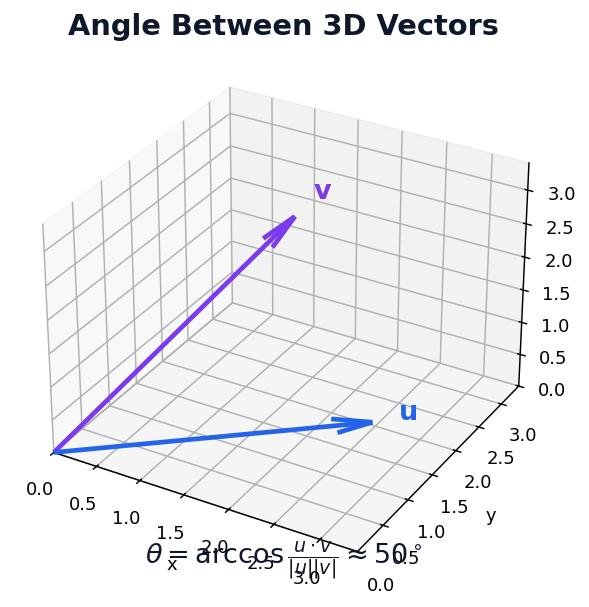
Three-dimensional vectors include an additional z-component. For 3D vectors a = (x₁, y₁, z₁) and b = (x₂, y₂, z₂):
The magnitudes extend to include the z-component:
- |a| = √(x₁² + y₁² + z₁²)
- |b| = √(x₂² + y₂² + z₂²)
Despite the additional dimension, the fundamental approach remains identical, demonstrating the elegance of vector algebra.
Real-World Applications of Angle Between Vectors
Understanding the angle between vectors has numerous practical applications across various fields:
Computer Graphics and Game Development
Game engines constantly calculate angles between vectors for lighting effects, camera positioning, and collision detection. The angle determines how light reflects off surfaces and how objects interact in 3D space.
Machine Learning and Data Science
In machine learning algorithms, vector angles measure similarity between data points. Smaller angles indicate greater similarity, making this calculation essential for clustering and recommendation systems.
Physics and Engineering
Engineers use vector angles to analyze forces, calculate work done by forces, and determine moments. The angle between force and displacement vectors directly affects energy calculations.
Navigation and GPS Systems
GPS technology relies on vector calculations to determine direction and bearing. The angle between position vectors helps calculate the shortest path between two points.
Computer Vision
Image recognition algorithms use vector angles to identify patterns and features. The angle between feature vectors helps classify and recognize objects in images.
Worked Examples: Angle Between Vectors
Example 1: Simple 2D Vectors
Find the angle between vectors a = (3, 4) and b = (1, 2):
- Dot product: a · b = (3)(1) + (4)(2) = 3 + 8 = 11
- Magnitude of a: |a| = √(3² + 4²) = √25 = 5
- Magnitude of b: |b| = √(1² + 2²) = √5 ≈ 2.236
- Cosine: cos(θ) = 11 / (5 × 2.236) = 0.9839
- Angle: θ = arccos(0.9839) ≈ 0.179 radians ≈ 10.3°
Example 2: Perpendicular Vectors
Verify that vectors a = (2, 3) and b = (-3, 2) are perpendicular:
- Dot product: a · b = (2)(-3) + (3)(2) = -6 + 6 = 0
- When the dot product equals zero, cos(θ) = 0, meaning θ = 90°
This example demonstrates a quick method to check for perpendicularity without calculating magnitudes.
Example 3: 3D Vectors
Calculate the angle between a = (1, 2, 3) and b = (4, 5, 6):
- Dot product: a · b = (1)(4) + (2)(5) + (3)(6) = 4 + 10 + 18 = 32
- Magnitude of a: |a| = √(1² + 2² + 3²) = √14 ≈ 3.742
- Magnitude of b: |b| = √(4² + 5² + 6²) = √77 ≈ 8.775
- Cosine: cos(θ) = 32 / (3.742 × 8.775) = 0.9746
- Angle: θ = arccos(0.9746) ≈ 0.226 radians ≈ 12.9°
Frequently Asked Questions
Can the angle between vectors be greater than 180°?
No, the angle between vectors is always between 0° and 180°. This is because the dot product formula naturally yields the smaller angle between the two directions.
What does it mean when the angle is 90°?
An angle of 90° (π/2 radians) indicates that the vectors are orthogonal or perpendicular. Their dot product equals zero, and they have no component in each other’s direction.
How do I convert radians to degrees?
Multiply the radian measure by 180/π (approximately 57.2958). Most calculators have built-in conversion functions.
What if one vector has zero magnitude?
The angle is undefined for zero vectors because division by zero occurs in the formula. Ensure both vectors have non-zero magnitudes before calculating.
Does vector order matter in angle calculations?
No, the angle between vectors is commutative. The angle from a to b equals the angle from b to a because the dot product and magnitude calculations are symmetric.
Additional Resources
To deepen your understanding of vectors and related concepts, explore these valuable resources:
- Vector Mathematics on Wikipedia
- Interactive Vector Tutorials
- Dot Product Calculator
- Cross Product Calculator
- Vector Magnitude Calculator
Conclusion
Mastering the angle between vectors calculation opens doors to understanding countless applications in mathematics, physics, and computer science. Whether you’re analyzing forces in engineering, developing game mechanics, or implementing machine learning algorithms, this fundamental concept proves invaluable.
Our angle between vectors calculator simplifies these calculations while providing educational insights through step-by-step solutions. Use it to check your homework, verify engineering calculations, or simply explore how vectors interact in 2D and 3D space.
Remember: practice makes perfect. Try calculating angles between different vectors to build intuition about how vector orientation affects their relationship. Start with simple 2D examples and gradually work your way up to complex 3D scenarios.