Matrix Equality Checker: Verify Matrix Equality in 3 Simple Steps
Determining whether two matrices are equal is a fundamental operation in linear algebra and matrix mathematics. Our free matrix equality checker instantly compares matrices of any size and provides detailed verification to help you understand the equality conditions.
What is Matrix Equality?
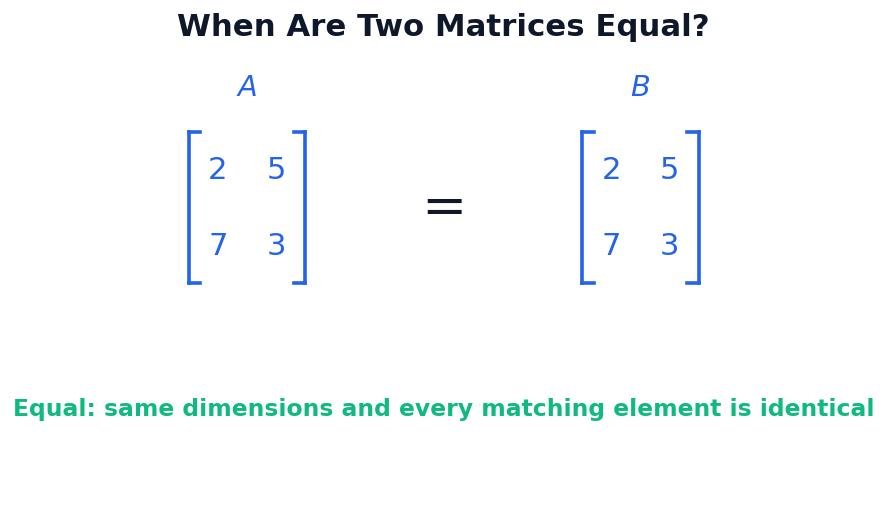
Two matrices are considered equal matrices if and only if they satisfy specific mathematical conditions. Matrix equality is not just about having similar values; it requires exact correspondence in dimensions and every individual element.
In mathematical notation, if we have matrices A and B, we write A = B when they are equal. This equality has precise requirements that must all be met simultaneously for the statement to be true.
Conditions for Matrix Equality
For two matrices to be equal matrices, they must satisfy three essential conditions:
Condition 1: Same Number of Rows
Both matrices must have an identical number of rows. A 3×2 matrix cannot be equal to a 2×2 matrix, regardless of the element values. This is a fundamental structural requirement.
Condition 2: Same Number of Columns
The matrices must have the same number of columns. Even if matrices have the same number of rows, they cannot be equal if their column counts differ. A 2×3 matrix can never equal a 2×4 matrix.
Condition 3: All Corresponding Elements Are Equal
Every element at position (i, j) in matrix A must equal the element at position (i, j) in matrix B. This means:
If matrices A and B are m×n matrices, then all m×n elements must match exactly.
Matrix A = [1, 2]
[3, 4]
Matrix B = [1, 2]
[3, 4]
These matrices are equal because they have the same dimensions (2×2) and all corresponding elements match.
How to Check Matrix Equality: 3 Simple Steps
Follow this systematic approach to determine if two matrices are equal:
Step 1: Verify Dimension Compatibility
First, check that both matrices have the same dimensions. Count the rows and columns in each matrix:
- If matrix A is m×n, matrix B must also be m×n
- If dimensions differ, the matrices cannot be equal
- This is the quickest way to eliminate non-equal matrices
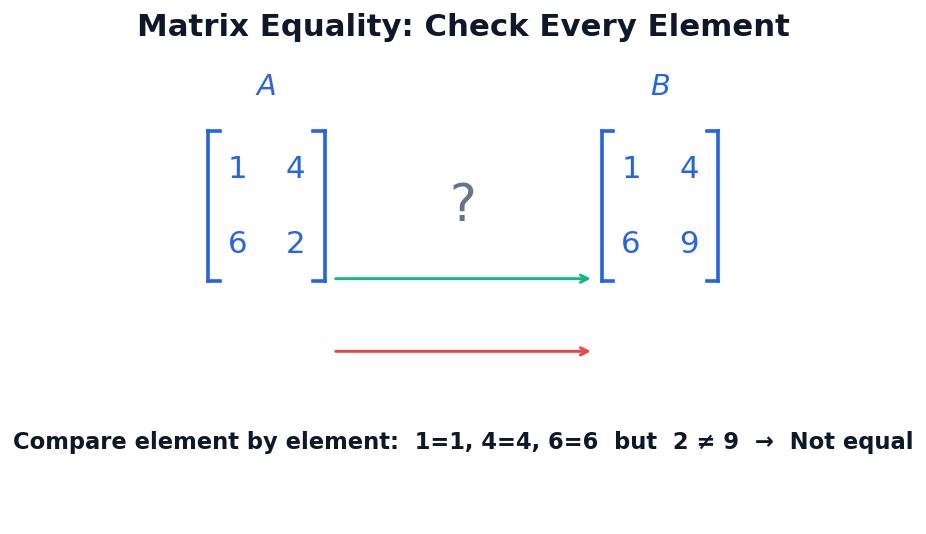
Step 2: Compare Elements Systematically
Once dimensions match, compare each element position by position:
- Start with element (1,1) in both matrices
- Proceed row by row, column by column
- Check that A[i,j] = B[i,j] for every position
- Stop at the first mismatch if you’re doing this manually
Step 3: Verify Complete Equality
After checking all elements:
- If all elements match, the matrices are equal
- If any single element differs, the matrices are not equal
- Document which element(s) caused the inequality
Worked Examples of Matrix Equality
Example 1: Equal 2×2 Matrices
Matrix A:
[5, 7]
[2, 9]
Matrix B:
[5, 7]
[2, 9]
Analysis:
- Both matrices: 2×2 ✓
- A[1,1] = B[1,1] = 5 ✓
- A[1,2] = B[1,2] = 7 ✓
- A[2,1] = B[2,1] = 2 ✓
- A[2,2] = B[2,2] = 9 ✓
Result: Matrices are EQUAL
Example 2: Unequal Matrices (Different Elements)
Matrix A:
[1, 2, 3]
[4, 5, 6]
Matrix B:
[1, 2, 3]
[4, 8, 6]
Analysis:
- Both matrices: 2×3 ✓
- A[2,2] = 5 but B[2,2] = 8 ✗
Result: Matrices are NOT EQUAL
Example 3: Unequal Matrices (Different Dimensions)
Matrix A:
[1, 2]
[3, 4]
[5, 6]
Matrix B:
[1, 2]
[3, 4]
Analysis:
- Matrix A: 3×2
- Matrix B: 2×2
- Different dimensions ✗
Result: Matrices are NOT EQUAL
Properties of Equal Matrices
When working with matrix equality, understanding these properties helps in various mathematical operations:
Reflexive Property
Any matrix is equal to itself: A = A. This seems obvious but is formally important in mathematical proofs and matrix theory.
Symmetric Property
If matrix A equals matrix B, then matrix B equals matrix A: If A = B, then B = A. The order of comparison doesn’t matter.
Transitive Property
If A = B and B = C, then A = C. This property is crucial when working with multiple matrix equations or systems.
Element-wise Operations
When matrices are equal, any identical operation performed on both yields equal results. For example, if A = B, then 2A = 2B.
Real-World Applications of Matrix Equality
Checking matrix equality is essential in numerous practical applications:
Computer Graphics and Image Processing
In computer graphics, matrices represent transformations. Checking if two transformation matrices are equal helps verify that two operations produce the same visual result. Image comparison algorithms use matrix equality to detect changes between frames.
Machine Learning Model Verification
In machine learning, weight matrices must be compared to verify model consistency across different training runs or to check if model parameters have converged.
Engineering and Physics Simulations
Engineers use matrix equality to verify that simulation results match expected outcomes. In structural analysis, stiffness matrices must be checked for consistency.
Data Validation and Quality Control
Database systems use matrix equality checks to validate data integrity. When data is stored in matrix format, equality checks ensure data hasn’t been corrupted during transmission or storage.
Cryptography
Many encryption algorithms rely on matrix operations. Matrix equality verification is crucial for decryption validation and key verification.
Scientific Computing
Numerical methods often require comparing matrices to check convergence criteria or validate iterative solutions. Scientific simulations depend on accurate matrix equality checks.
Common Mistakes to Avoid
Mistake 1: Ignoring Dimension Requirements
Many beginners assume that having the same elements in different arrangements means matrices are equal. Remember: [1,2,3] as a row vector is NOT equal to [1,2,3] as a column vector because their dimensions differ.
Mistake 2: Confusing Equality with Similarity
Two matrices might be “similar” in linear algebra (related by a transformation), but this doesn’t mean they’re equal. Matrix equality requires exact element-by-element matching.
Mistake 3: Floating Point Comparison Issues
When comparing matrices with decimal values computed from calculations, be aware of floating-point precision errors. Values like 0.1 + 0.2 might not exactly equal 0.3 in computer arithmetic. Use appropriate tolerance thresholds.
Mistake 4: Not Checking All Elements
Don’t assume matrices are equal just because the first few elements match. Always verify ALL corresponding elements, especially in large matrices.
Frequently Asked Questions
Can a matrix be equal to its transpose?
Yes, this creates a symmetric matrix. A matrix A equals its transpose A^T only when A[i,j] = A[j,i] for all elements. This occurs in symmetric matrices where the matrix mirrors across its main diagonal.
Are zero matrices always equal?
No, zero matrices are only equal if they have the same dimensions. A 2×2 zero matrix is not equal to a 3×3 zero matrix, even though all their elements are zero.
What about nearly equal matrices?
In pure mathematics, matrices are equal only when perfectly identical. However, in numerical computing, we often use “approximately equal” with a small tolerance (epsilon) to account for rounding errors.
Can diagonal matrices be equal to non-diagonal matrices?
Yes, if the non-diagonal matrix happens to have zeros in all non-diagonal positions and the diagonal values match. The structure doesn’t matter—only the actual element values.
How do I check equality programmatically?
Most programming languages provide built-in functions. In Python (NumPy): np.array_equal(A, B). In MATLAB: isequal(A, B). These functions handle dimension and element checking automatically.
Does matrix equality depend on the data type?
In strict mathematical terms, values must match regardless of representation. However, in programming, integer 5 and floating-point 5.0 might be treated differently by some equality checks. Always verify your comparison handles type conversions appropriately.
Matrix Equality in Linear Algebra
In the broader context of linear algebra, matrix equality serves as a foundation for more complex concepts:
- Matrix equations: Solving AX = B requires understanding when two matrices are equal
- Linear transformations: Verifying that two transformations are identical
- Vector spaces: Comparing basis representations
- Eigenvalue problems: Checking if characteristic matrices match
Additional Matrix Tools
Expand your matrix calculation capabilities with these related tools:
- Matrix Addition Calculator
- Matrix Multiplication Calculator
- Matrix Determinant Calculator
- Matrix Inverse Calculator
- Matrix Transpose Calculator
Conclusion
Understanding matrix equality is fundamental to linear algebra, computer science, and numerous engineering applications. Our matrix equality checker simplifies this verification process while helping you learn the underlying principles.
Remember the three essential conditions: same number of rows, same number of columns, and identical corresponding elements. When all three conditions are met, you can confidently state that two matrices are equal.
Whether you’re validating homework solutions, debugging code, or verifying scientific calculations, accurate matrix equality checking ensures mathematical precision. Use our tool above to quickly verify any pair of matrices and gain insights into why they are or aren’t equal.
Master this fundamental concept, and you’ll have a solid foundation for more advanced matrix operations and linear algebra applications.