Partial Derivative Calculator ∂/∂x
Differentiate a multivariable function with respect to one variable, holding the others constant.
Show working (LaTeX)
Use * for multiply and ^ for powers. Other variables are treated as constants.
This free partial derivative calculator differentiates a multivariable function with respect to one variable while treating the others as constants — shown in clean LaTeX.
How to use the partial derivative calculator
Type your function and the variable to differentiate by, then press Differentiate. The partial derivative calculator holds the other variables constant and returns the simplified partial. As a multivariable derivative calculator and partial differentiation calculator, it handles polynomials, trig, exponentials and more.
What is a partial derivative?
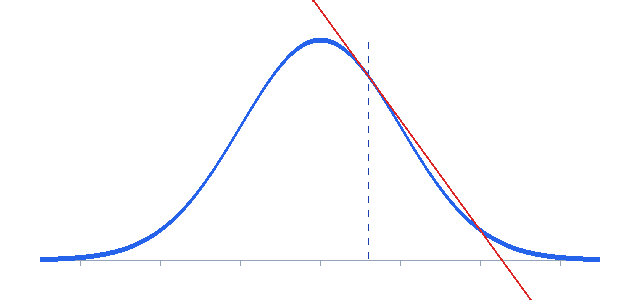
A partial derivative measures how a function changes as one variable changes, with the others held fixed. See the partial derivative reference for the formal definition.
Partial derivative formula
$$\frac{\partial f}{\partial x}=\lim_{h\to0}\frac{f(x+h,y)-f(x,y)}{h}$$How to take a partial derivative step by step
- Pick the variable to differentiate by.
- Treat all other variables as constants.
- Differentiate as usual with the standard rules.
Worked example
For $f(x,y)=x^2y+y^3$, the partial with respect to x is $\frac{\partial f}{\partial x}=2xy$, because $y^3$ is constant in x.
Why partial derivatives matter in machine learning
Partial derivatives are the heart of training in machine learning for beginners: the gradient is just the vector of partial derivatives of the loss with respect to each weight. They extend the single-variable derivative and power calculus-based optimization.
🤖 ML insight
Gradient descent updates every weight using its partial derivative of the loss, so the model learns by nudging each parameter in the direction that reduces error.
Frequently asked questions
How do I choose the variable?
How are the other variables handled?
Can it do second partial derivatives?
What is the gradient?
Is the partial derivative calculator free?
Gradients and higher partials
Collecting every first partial into a vector gives the gradient, which points in the direction of steepest increase. Differentiating a partial again produces a second-order partial; the mixed partials are equal for smooth functions, a fact known as Clairaut’s theorem.
In practice you rarely compute these by hand for large models. Automatic differentiation libraries apply the chain rule across millions of operations to get every partial efficiently — but understanding what a single one means is what makes the gradient, and gradient descent, click.
Partial derivative calculator: summary
This partial derivative calculator differentiates multivariable functions one variable at a time. Pair it with the derivative calculator and the integral calculator.